
Manchester City vs Napoli Preview: Prediction, Probable Lineups, Tactics, Team News & Key Stats
Manchester City vs Napoli at the Etihad on Tuesday will be a battle of two teams that have embarked on opposing trajectories in 2026/27 UEFA Champions League.
Napoli’s 1-0 win over Torino, settled by Scott McTominay’s 73rd-minute finish, offered a brief domestic lift before a much harder examination in the midweek UEFA Champions League clash. Manchester City arrive after beating RB Leipzig 3-2 away on Matchday 4, but the 1-1 home draw with Fulham extended their winless Premier League run to four matches.
This league-phase meeting is therefore about progression for both sides. City are trying to protect a strong European position, while Napoli need a result to revive a campaign that has become increasingly difficult to trust.
For City, avoiding another defensive lapse matters as much as adding another victory. They are seventh in the standings after three wins and one defeat from four matches, with the top eight moving directly into the Round of 16. So, another positive result would reinforce their route through the competition.
The cost of dropping points is less immediate than allowing the domestic uncertainty to follow them into Europe. Their recent win at Leipzig showed the attacking response still exists, but the draw over the weekend made the defensive concern harder to dismiss. Enzo Maresca has also identified the opening phase as a particular weakness, with nearly 80% of their conceded goals arriving in the first 20 minutes.
Napoli, on the other hand, need something more restorative. Their win over Torino stopped the immediate domestic slide, yet they have won only two of their last ten Champions League matches and remain without an away European victory in eight attempts. Their four league-phase matches have brought 11 goals against them, while their European morale has stayed fragile.
A draw would give Massimiliano Allegri a platform to manage the game and rebuild belief; a defeat would leave the injury-hit squad facing another damaging result against elite opposition. City’s attacking threat makes that pressure especially severe, even if Napoli can use the direct game that helped them against Torino.
Team News: The likely selections and the gaps Napoli must cover
Antoine Semenyo is the only player missing for City, with the Ghanaian international out with a knee injury and expected back in December. His absence removes one wide option, but the structure can still use Jeremy Doku and Iliman Ndiaye behind Erling Haaland.
Gianluigi Donnarumma should hold the goalkeeping position, with Marc Guehi and Ruben Dias expected to form the central pairing. Josko Gvardiol is likely to start as the left-back, with Abdukodir Khusanov taking the other side of the defence.
As for the midfield unit, Enzo Fernandez and Elliot Anderson are expected to make up the double pivot, an important selection because City’s plan needs two players able to protect the centre while the attacking line advances. Fernandez has supplied two assists and 11 key passes in four appearances, while Anderson has added a goal and an assist across his four matches. Erling Haaland leads the line after scoring five times from 17 shots, including 10 efforts on target.
Probable Manchester City Starting Lineup (4-2-3-1): Donnarumma; Khusanov, Dias, Guehi, Gvardiol; Anderson, Fernandez; Ndiaye, Cherki, Doku; Haaland
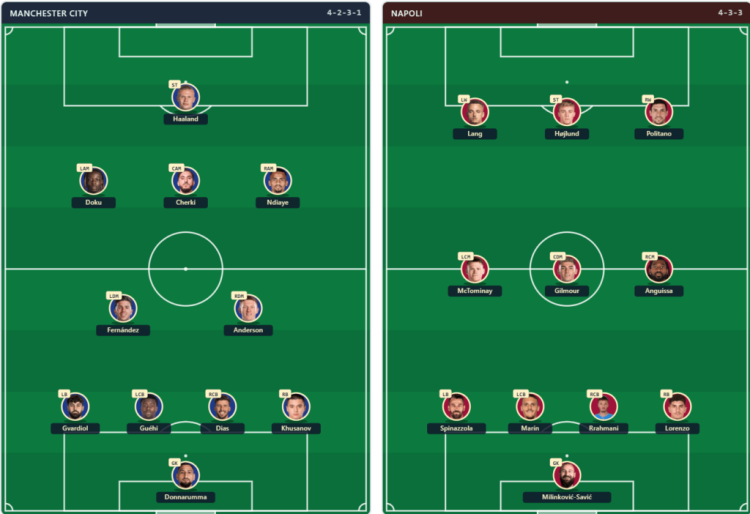
Probable Napoli Starting Lineup (4-3-3): Milinkovic-Savic; Di Lorenzo, Rrahmani, Marin, Spinazzola; Anguissa, Gilmour, McTominay; Politano; Hojlund, Lang
Napoli’s absences are more disruptive. Stanislav Lobotka is out with an ankle injury, Alex Meret is unavailable with a lumbar vertebra fracture, Alessandro Buongiorno is out after knee surgery, and Benoît Badiashile is missing with a hamstring strain. That removes a goalkeeper and several defensive options, while Lobotka’s absence leaves the midfield without a key starter.
Vanja Milinkovic-Savic is an automatic pick between the sticks, with Giovanni Di Lorenzo and Amir Rrahmani expected to anchor the defensive line. Rrahmani has started all four of his appearances and has scored once, but Napoli will need more than his individual reliability against Haaland.
Leonardo Spinazzola is likely to provide the left-sided width after recording four key passes in two appearances. Rafa Marin should play alongside Rrahmani. As for the midfield unit, Andre-Frank Zambo Anguissa is expected to complete the trifecta alongside Billy Gilmour and Scott McTominay despite a difficult current spell.
McTominay is the runner Napoli will want higher up the pitch, with the Scot three goals in three starts. Noa Lang should start on the left and Matteo Politano on the right; Politano has contributed a goal, an assist and six key passes in four appearances. Rasmus Hojlund is likely to lead the line, though his four starts have produced no goals and only two shots on target. So, former Manchester City playmaker Kevin De Bruyne will feature off the bench on Tuesday.
Tactics: City’s two-man platform vs Napoli’s running outlet
Manchester City should use a 4-2-3-1 setup that carries the game forward without removing its own cover. Enzo Fernandez and Elliot Anderson sit behind Rayan Cherki, Jeremy Doku, and Iliman Ndiaye, giving Erling Haaland a supply line while preserving protection in front of Marc Guehi and Ruben Dias.
They are expected to play on the front foot, but within that structure rather than by sending every player forward. Napoli’s defensive uncertainty gives City reason to press the advantage, yet the recent vulnerability to early concessions means the double pivot cannot simply abandon its position.
The profile supports a possession-led City performance. The hosts have had 64% of the ball per match against Napoli’s 45.5%, with the UEFA Champions League typical so far at 51%. So, the central question is whether the away side can remain compact while spending long spells without possession.
City have also averaged 21.5 take-ons against the league’s typical 17, while Napoli have averaged 8.5. That difference points to a game in which Doku, Ndiaye, and the players behind Haaland may try to carry the ball through or around the visitors’ first defensive line rather than wait for a patient opening. Meanwhile, Napoli’s 4-3-3 system is built to keep the match manageable.
The Partenopei can accept less of the ball, keep three midfielders near the centre-backs and settle for the draw if City do not create a decisive opening. Their ball share is below the league norm, and their lower take-on rate suggests a side more comfortable escaping pressure through a direct outlet than repeatedly dribbling through it.
Rasmus Hojlund gives them that reference point, while Scott McTominay must move close enough to make the first pass forward meaningful. Napoli will take risks when the route is available, but they are unlikely to turn the game into an uncontrolled exchange from the start. That makes Anderson against McTominay the main contest.
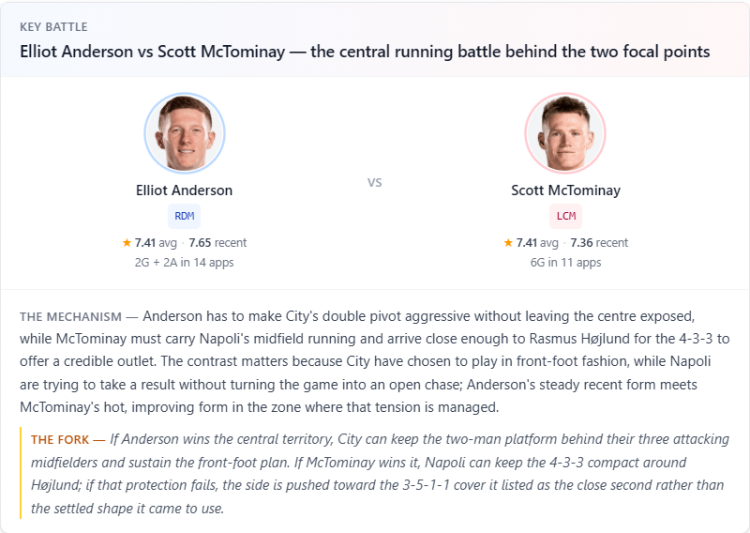
Anderson must step forward from Manchester City’s double pivot without leaving the centre exposed. McTominay has to cover Napoli’s midfield running and arrive near Hojlund quickly enough for the 4-3-3 to relieve pressure. Anderson has been steady rather than spectacular in this role, while his opposite number brings the stronger current momentum, so the duel is not simply about City imposing their preferred rhythm.
If Anderson wins the central territory, City can keep their two-man platform and sustain attacks. If McTominay wins it, Napoli can keep the midfield close to Hojlund and make the hosts recycle possession away from the penalty area. Should that protection fail, Napoli may need to switch to a 3-5-1-1 and add a central defender rather than continue defending the same spaces with an exposed four. The second important battle comes after the first duel.
Haaland will occupy Amir Rrahmani and test whether the Napoli defender pairing can preserve the compactness that makes the 4-3-3 shape viable. If Rrahmani holds the line, the visitors can keep their chosen shape and wait for the direct ball to Hojlund.
If Haaland breaks that reference, the three-man midfield will no longer be enough protection, and Napoli will be pushed toward the central overload they have kept as an alternative. City, meanwhile, should be able to retain their attacking structure rather than immediately add a third holding midfielder.
Prediction: Why the home side has the stronger betting case
We predict a Manchester City win, but only with moderate confidence rather than certainty. Their recent attacking baseline is stronger. Enzo Maresca’s men have averaged 1.96 xG across their last five matches, compared with Napoli’s 1.54. The xGD also favours City, at 2.05 against Napoli’s 0.256.
That is the clearest separation between the teams when the tactical picture becomes less clean; City have more ways to turn territorial control into chances. The strongest case against the home win is Napoli scoring early. City have conceded nine goals across their last five matches, and the opening-phase weakness identified by Maresca gives Napoli a specific route into the game.
Lean: Manchester City win
Range: 2-1/2-0/1-1
Rasmus Hojlund can offer a direct target, Scott McTominay can attack the second ball, and one successful early passage would force City to play against the very anxiety their possession is meant to suppress. Napoli do not need to dominate for that to matter; they need one effective escape from pressure before City settle into their structure.
The likeliest scoreline range is 2-1 or 2-0 to City, with 1-1 the main alternative. Napoli’s ability to keep Hojlund involved decides whether the match stays close, but City’s stronger attacking production and greater capacity to sustain pressure make the home result the more likely landing point.
The adjustment that could change Napoli’s defensive picture
Manchester City have a clear in-game change if Napoli’s midfield begins to reach Rasmus Hojlund too easily. They can move from the 4-2-3-1 formation into a 4-1-4-1 shape and add another central screen.
Napoli’s corresponding switch to a back three would be more demanding because it asks already stretched defensive resources to cover wider areas. That gives City the cleaner adjustment if the opening plan becomes too open, and it is one reason the home side remains the safer match result despite the early-concession risk.
Comment / Reply From
You May Also Like