
Galatasaray vs Aston Villa Preview: Prediction, Probable Lineups, Tactics, Team News & Key Stats
Galatasaray vs Aston Villa at Rams Park on Tuesday will be a crucial UEFA Champions League fixture where three points will be crucial for each side for different reasons.
A 3-0 defeat at Barcelona ended Aston Villa’s perfect start to the 2026/27 UEFA Champions League and left them needing a response, while Galatasaray beat VfB Stuttgart on Matchday 4. Cimbom also overcame Samsunspor at the weekend to move three points clear at the top of the Turkish Super Lig.
This first European meeting between the clubs therefore carries different pressure on each side. Galatasaray are chasing the points that could keep their Champions League campaign moving, while Villa are trying to steady theirs and consolidate their top-eight position.
Galatasaray’s result would be valuable because another win would strengthen their group-progression challenge; a draw would leave them short of the momentum they want, while defeat would make the route forward more difficult. Their seven-match winning streak gives them a strong platform, and the 2-0 victory over Stuttgart remains a useful marker of their European level. They also bring the confidence of a side that has won six of its last ten home matches against English opposition. The difficulty is that their main central reference in attack is unavailable, so the win must be pursued through a different connection between midfield and the striker.
Villa can afford to manage the match more carefully. Their three wins in four European games have put them in a strong position, but the Barcelona defeat exposed the cost of losing control, and their latest league outing ended in a goalless draw against Sunderland despite sustained pressure. A draw here would keep their campaign moving, whereas another defeat would turn the Barcelona setback into a more serious sequence. They arrive with a more cautious European calculation than Galatasaray, even if the hosts’ momentum means Villa cannot simply protect the point from the start.
Team News: The replacement striker changes Galatasaray’s selection call
Galatasaray are without Kaan Ayhan, Roland Sallai (thigh), Victor Osimhen (knee), Rafael Leao (hamstring), Kazimcan Karatas, Eyup Aydin, Arda Unyay, Armando Guner, and Arda Yilmaz. Ismail Jakobs is doubtful with a groin injury, while Ugurcan Cakir is returning from a shoulder problem and is nevertheless expected to hold the goalkeeping position.
Osimhen’s absence matters most to the XI. It removes the established focal point and leaves Deniz Gul likely to lead the line, although Gul has only played 32 minutes from two substitute appearances this season. The rest of the selection for the home side should retain the 4-2-3-1 that has been used throughout Galatasaray’s recent run.
Davinson Sanchez will be the right-sided centre-back, while Abdulkerim Bardakci is expected to join him on the left. Lucas Torreira should screen the defence from the right of the double pivot, though his current form has been below his usual level. Mario Lemina is likely to complete the pair, giving the shape the extra protection it needs when the attacking midfielders push forward.
The main attacking responsibility falls behind the striker. Aleksey Batrakov starts centrally after scoring four goals in four UEFA Champions League appearances, with five of his five shots on target and a 7.4 average rating. Yunus Akgun should keep the right attacking-midfield slot after recording eight key passes and two shots on target from two attempts.
Baris Alper Yilmaz is expected on the left, where he gives Galatasaray another route to support the inexperienced striker Deniz Gul. Eren Elmali and Wilfried Singo are the more provisional full-back calls, and the right-back decision could determine how safely the home side attacks.
Probable Galatasaray Starting Lineup (4-2-3-1): Cakir; Singo, Sanchez, Bardakci, Elmali; Torreira, Lemina; Akgun, Batrakov, Yilmaz; Gul
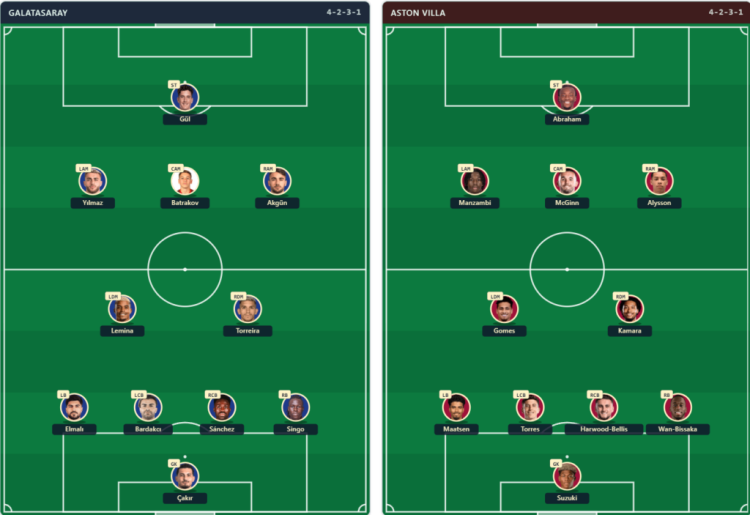
Probable Aston Villa Starting Lineup (4-2-3-1): Suzuki; Wan-Bissaka, Harwood-Bellis, Pau Torres, Maatsen; Kamara, Joao Gomes; Alysson, McGinn, Manzambi; Abraham
Aston Villa are missing Amadou Onana due to a cruciate ligament tear. Matty Cash remains in concussion protocol and Victor Lindelof is doubtful because of illness. So, the defensive line carries more uncertainty than the midfield.
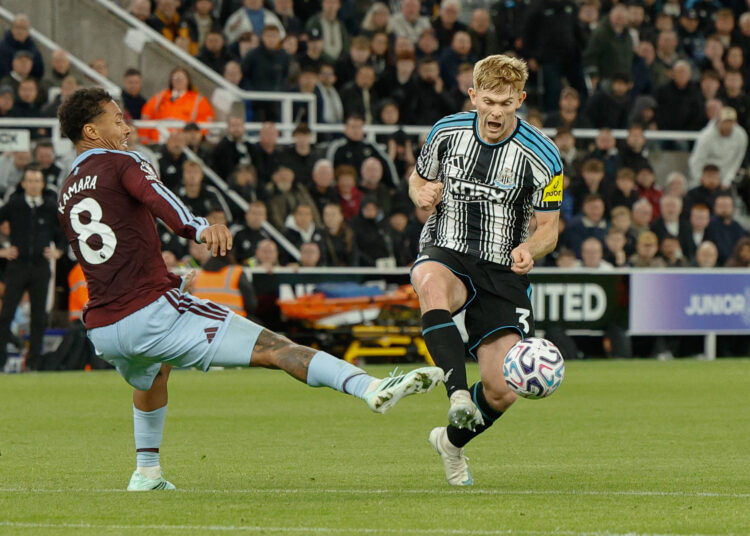
Aaron Wan-Bissaka is set to deputise at right-back, while Taylor Harwood-Bellis should continue at right centre-back in Lindelof’s absence. Pau Torres brings greater continuity on the other side, having played every minute of four appearances and supplied two assists. Villa’s double pivot should be Boubacar Kamara and Joao Gomes.
The former gives the side its main defensive reference, while Gomes has shown impressive creativity. John McGinn remains the central attacking midfielder, with eight key passes, three big chances created, and four shots on target from six attempts. Johan Manzambi and Alysson should flank the skipper, with both players being in impressive form. Tammy Abraham is expected to lead the line, with Nicolas Jackson getting some rest.
Tactics: Batrakov asks the question Villa’s double pivot must answer
Both teams are expected to use a 4-2-3-1 formation, but they will not use it in the same way. Galatasaray should carry the game toward Aston Villa while keeping the double pivot behind the attacking midfield trifecta. That offers protection for the replacement striker, but it also asks Aleksey Batrakov, Yunus Akgun and Baris Alper Yilmaz to stay close enough to him for the pressure to last.
Galatasaray’s recent European output has been modest underneath the winning sequence, with 1.05 xG per match and 1.87 xGA per match. Their structure must create better links around the striker rather than relying on an absent focal point. Aston Villa should also have three attacking midfielders around a lone forward, but their approach is more measured.
They can try to win while accepting a draw if the game does not open safely, keeping two midfielders behind the attack instead of adding another forward. Their ball share is 40.5% per match compared with a league typical 51.0%, so they have not generally made territorial control their defining habit. The Villans also average 11.5 crosses against the league’s 14.5, suggesting a side that has not consistently made width and deliveries its main attacking route.
That makes Aston Villa’s recent performance against Sunderland an important complication rather than a settled template. They had 72% possession and 18 shots in the 0-0 draw. However, Galatasaray will not be obliged to defend that much territory if the away side cannot reproduce the same control.
Villa’s shape can keep the match organised. Yet, the home side’s willingness to advance should test whether possession becomes genuine penetration or simply another controlled but unproductive spell. The central duel is Aleksey Batrakov against Boubacar Kamara.
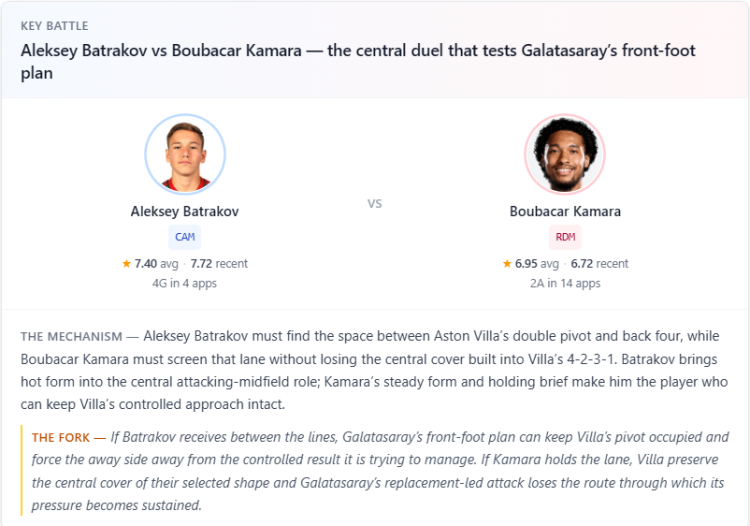
Batrakov is the attacking midfielder who can receive between the lines and force Aston Villa’s double pivot to turn toward its own goal; Kamara is the holder who must screen that lane without abandoning the central cover behind him. The in-demand Galatasaray playmaker arrives with four goals in four appearances.
On the other hand, Kamara’s steadier holding role is less about joining the final action than preventing the home side from making repeated central entries. If Batrakov receives cleanly, Galatasaray can keep the Aston Villa midfielder occupied and make Villa defend deeper than their preferred controlled approach requires.
That would give the home side’s attacking midfielders time to surround the replacement striker and sustain pressure. If Kamara holds the lane, Aston Villa preserve the protection built into their shape and force Galatasaray toward less direct routes around the box. The consequence is larger because there is no spare holder behind Batrakov once he escapes the first screen.
Villa’s centre-backs would then have to decide whether to step out or protect Tammy Abraham’s side of the pitch. On the right, Wilfried Singo’s against Johan Manzambi offers a second route into the match. The Swiss international can use the outside lane to turn the away side’s left side into territory and make Galatasaray’s advancing shape retreat.
Singo has barely featured, so containment rather than adventurous support may be the sensible priority for the home side. If he manages that job, Villa are pushed back toward the draw-acceptable approach; if Manzambi gets beyond him, Galatasaray’s pressure can become stretched across the whole back four.
Prediction: The home side has the sharper route to a decisive moment
We predict a Galatasaray win, but only with medium conviction. Their attacking structure has a clear answer to Aston Villa’s central cover in Aleksey Batrakov, and playing at home should encourage the more assertive side to keep testing a defence that has conceded 2.06 xG per match across its recent sample.
Galatasaray’s own attacking average is only 1.05 xG. So, this is not a case for assuming a relentless home performance; it is a case for believing that one central breakthrough may be enough. The strongest argument against the home win is Villa’s ability to control the match without chasing it recklessly.
Lean: Galatasaray win
Range: 2-1/1-0/1-2
The draw with Sunderland showed that they can dominate possession and produce shots, and Boubacar Kamara’s positioning could deny Batrakov the space Galatasaray need. If Villa move the ball safely, keep Johan Manzambi and Alysson connected to the midfield, and make the home side’s replacement striker defend long phases with his back to goal, the game can become a low-margin contest in which Galatasaray’s aggressive approach creates little.
The prediction settles in the 2-1, 1-0 or 1-2 range. Galatasaray’s recent Champions League xGD of 3.789 is the stronger underlying attacking signal between the sides. However, their missing focal point and Aston Villa’s capacity to preserve structure keep the draw live.
The final right-back call may decide how far Galatasaray can commit
The selection that could still alter the match is Galatasaray’s right-back choice. A conservative performance there would allow the home side’s double pivot to remain close to the defence while the attacking midfielders work around Aston Villa’s screen.
A more aggressive interpretation would give Galatasaray another player beyond Manzambi, but it would also leave more space for Villa’s left-sided outlet if the first pressure is beaten. That balance may determine whether the hosts can sustain their preferred attacking posture without turning one lost duel into an away goal.
Comment / Reply From
You May Also Like