
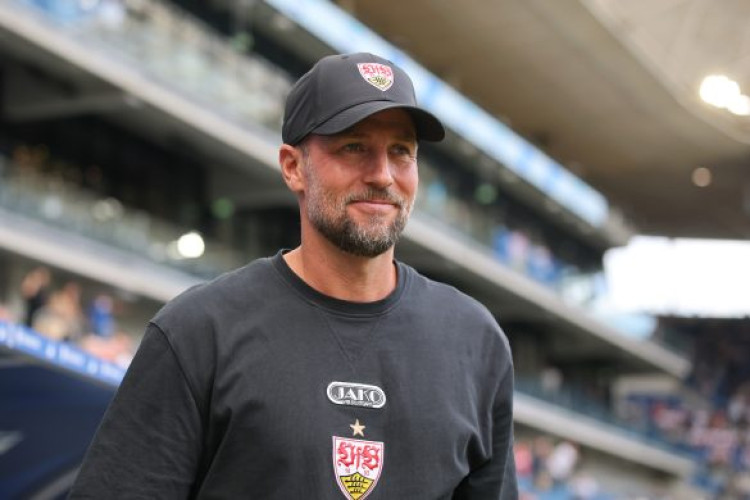
Bundesliga Tactics Check | VfB Stuttgart
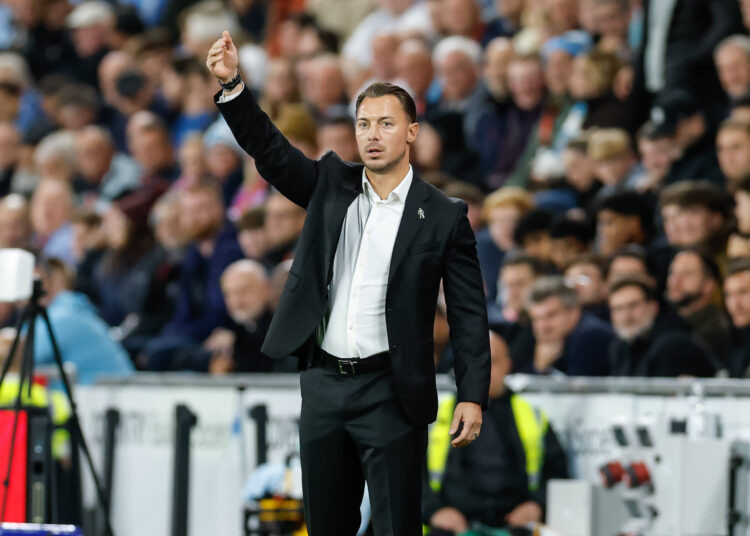
As part of an ongoing series during the 2026/27 Bundesliga campaign, Get German Football News is pleased to take a closer look at VfB Stuttgart, six competitive fixtures into a season in which Sebastian Hoeneß has already begun rearranging his overflowing tactical toy box. Three points from four Bundesliga matches. Fifteenth place. Six goals scored and nine conceded. Three defeats already.
There are certainly more elegant ways to begin a season in which Champions League qualification ostensibly re-established VfB Stuttgart as one of German football’s new upper-class residents. The emergency sirens needn’t be tested just yet, unless one happens to be perfectly Swabian about it and do such a thing.
Stuttgart opened away at Bayern Munich, have already played Borussia Dortmund, and also got their (exaggerated “mini-derby”) against BaWü rivals Hoffenheim out of the way. The one league fixture Sebastian Hoeneß’ side were plainly expected to win produced a 4-1 dismantling of Köln. A Champions League opening-match victory against the irresistibly named Viking Stavanger came as well.
The performances have generally been better than the current standing in the table suggests. Bayern provided the best example of this. Hoeneß’ team did significantly better than the 1-5 result would have one believe. More important than results in general, Stuttgart’s matches have provided their fair share of tactical intrigue.
Our summer preview concluded that Stuttgart’s preparation produced “less of a new tactical identity than an expansion of an already broad one.” Hoeneß used back fours, a 4-4-2, multiple forward partnerships, asymmetric wide structures, deeper playmakers and, most intriguingly, Nikolas Nartey as an inverted right-back.
Six competitive matches later, the most significant development is something else entirely. Hoeneß keeps reaching for a third centre-back. The 4-2-3-1 with which Stuttgart opened competitive play remains available. So does the free-ranging Deniz Undav role underneath a conventional striker.
The first month has increasingly pushed VfB towards three-man defensive structures, aggressive wingbacks and several different arrangements of the abundant attacking talent Hoeneß spent August attempting to squeeze onto one pitch.
Some things look better.
Some do not.
Let us empty the notebook.
Interesting Developments, Stuttgart
Hoeneß starts taking the back three seriously
We knew this was possible. The preseason squad was always equipped for a three-man defense, and Hoeneß used enough different structures during preparation to render any firm prediction hazardous to the author’s already questionable reputation. What we did not necessarily expect was how quickly the back three would become the dominant competitive structure.
The DFB-Pokal opener in Rostock began with the 4-2-3-1 we anticipated. Nartey started at right-back, Angelo Stiller and Grischa Prömel formed the double-six, Deniz Undav worked behind Dzenan Pejcinovic and the wingers occupied familiar territory. Nartey’s hamstring objected after nine minutes, frustratingly dating the whole damn Stuttgart preview section before the author could even announce its presence on social media.
The most interesting preseason experiment was immediately placed back on the shelf. Hoeneß responded by exploring another one. Stuttgart used a three-man defensive base in Munich, briefly returned to the back four against Köln, then started each of the next three matches against Stavanger, Hoffenheim and Dortmund with three central defenders.
The personnel changed. The interpretation changed. The broad idea remained. At Hoffenheim, Ramon Hendriks joined Jeff Chabot and Finn Jeltsch behind Vagnoman and Maximilian Mittelstädt. Against Dortmund, Hoeneß removed Hendriks without removing the system, instead dropping Mittelstädt into the left centre-back slot and pushing Chris Führich into a wingback role.
One can say that three at the back is no longer a Bayern-specific containment mechanism or a convenient response to one particular opponent. It has become a genuine component of Stuttgart’s emerging identity. What precisely Hoeneß hopes to gain from it may be something worth debating.
Against Hoffenheim, the structure produced tremendous width and attacking numbers but poor protection after turnovers. Against Dortmund, the same broad shape was considerably more compact and conceded very little. Neither match produced any points, however. Those need to come.
Josha Vagnoman stays and remains useful
There came a point late in the transfer window when Josha Vagnoman appeared close to leaving Stuttgart. Hull City kept pushing. An agreement between the clubs reportedly began taking shape. Stuttgart had already spent the summer experimenting with Nartey at right-back. Vagnoman looked like precisely the sort of squad player who might become surplus to requirements amid all the abundance.
He stayed. That turned out reasonably well. Vagnoman has already produced two goals and two assists across competitions. More important than the raw output is where the chances keep finding him. Were it not for Jürgen Klopp’s deep affection for Freiburg’s Philipp Treu, Vagnoman would be back starting for Germany on the right rail.
The 25-year-old repeatedly occupies Stuttgart’s most aggressive right-sided position. Against Köln, he attacked the box often enough to smash El Khannouss’ early cross against the bar before eventually scoring a spectacular late volley. At Hoffenheim, one of his forward bursts created Mittelstädt’s equaliser. Against Dortmund, Undav released him completely free through the right channel for Stuttgart’s clearest second-half chance.
Vagnoman is not merely an occasional overlapping fullback. In the back-three structures, he becomes one of the primary depth runners. He can hold the touchline, attack the opposing wingback, arrive at the far post or drive directly into the penalty area. The national-team recall under Jürgen Klopp rather neatly reflects how conspicuous his opening month has been.
The irony is enjoyable. Stuttgart spent part of August deciding whether Vagnoman remained necessary. By September, Hoeneß was building significant portions of the attack around him. Football does enjoy these little jokes. The Hamburg native – at the age of 25 – has effectively silenced all critics that once questioned his ability to compete at Bundesliga level.
El Khannouss looks ready again
Okay, everyone knows that the author is biased. Bilal El Khannouss’ poor AFCON and second half of the 2025/26 Bundesliga campaign together constitute one of the great personal heartbreaks of the author’s 2026 calendar year. Now he’s back. Kind of. The Moroccan’s 4-1 performance against Köln already received a more detailed treatment on these pages, so there is little need to reproduce all of it here. The author will still give it another sentence.
Against Köln, he created the early Vagnoman chance with a delicate cross, scored by simply carrying the ball through several defenders and then played the pass that released Mittelstädt before Prömel’s 2-0. Subsequent performances tended more towards average, but the Moroccan’s tactical significance remains meritorious. Hoeneß wants his attacking midfielders to interpret space rather than merely occupy a rectangle on a tactics graphic.
El Khannouss appears particularly well suited to the assignment. He has also defended with considerably more application than the lazy “luxury No. 10” stereotype would suggest. Any early assessment worth its salt should identify El Khannouss as the one Stuttgart attacker already operating consistently in rhythm. Mic drop.
The midfield counts as something of a confused mess
One summer question has already received its answer. Grischa Prömel won the job next to Angelo Stiller. The free-transfer arrival offered exactly the profile Hoeneß lacked last season: running power, duel strength and a genuine appetite for arriving inside the penalty area from deeper midfield. We saw the latter against Köln. Stiller organized. Prömel cleaned up behind attacks, then charged into the box and finished Mittelstädt’s cutback for the second goal.
That sounds rather tidy. The partnership itself remains less so. Stiller wants to collect from the centre-backs and govern Stuttgart’s first phase. Prömel wants to cover ground. Neither characteristic presents a problem independently. The difficulty comes in ensuring that their distances remain useful when possession breaks down and that both understand who protects which space once Stuttgart commit the wingbacks and attacking midfielders forward.
The early evidence remains mixed. The pair dominated Köln for long stretches. Against Bayern, Stiller found too few vertical solutions after dropping deep. Hoffenheim repeatedly found transitional space. Dortmund exposed Stuttgart on second balls and prevented either midfielder from controlling the centre consistently. We now arrive at the hierarchy developing behind them.
Former captain Atakan Karazor is no longer first reserve. When Stiller was forced out of the Hoffenheim match, Hoeneß called upon 19-year-old Yanik Spalt instead. The coach later explained that Spalt more closely resembles Stiller’s profile. One needn’t exaggerate the symbolism. One probably shouldn’t ignore it either. In point of fact, Karazor’s fall goes way beyond symbolism.
Karazor entered the summer as captain and established partner to Stiller. He leaves September without the armband, without the starting role and, in at least one important substitution sequence, behind a teenager (again if one considers the case of Chema Andres last year) in the central-midfield queue. With Stiller and Prömel struggling to gain chemistry, one wonders why this must be so.
Demirovic wins Round One
Stuttgart spent approximately €25m on Dzenan Pejcinovic because they believe the Germany U21 striker can become something special. The club’s persistence in completing the deal reflected precisely that conviction. His competitive debut was nearly perfect. Pejcinovic scored three times in Rostock. He remained the starting striker in Munich and against Köln. Stuttgart’s early attacking structure appeared designed around the young striker pinning the final line while Undav roamed underneath.
Then Ermedin Demirovic entered against Köln and scored. Four days later, Demirovic started against Stavanger and scored three more. Well then. Demirovic entered the summer with his own future unresolved. Hoeneß possessed Undav, wanted Pejcinovic and appeared at least open to reshuffling the striker department should a substantial offer arrive. None did.
Demirovic has since reminded everyone why keeping a proven Bundesliga goalscorer around might occasionally prove useful. The most encouraging aspect of the Stavanger hat-trick was the partnership with Undav. Undav created two goals from underneath while Demirovic concentrated on attacking the penalty area. That is essentially the same mechanism Hoeneß first used with Pejcinovic in Rostock.
The senior striker simply executed it more efficiently. Demirovic retained his place against Hoffenheim and Dortmund. Pejcinovic started alongside him in Sinsheim but returned to the bench against BVB. Round one goes to the Bosnian over the younger German-Montenegrin, who also still hasn’t made the leap from the U21s to Klopp’s XXL roster. Undav, meanwhile, has not yet looked like himself.
Achilles problems supply important context. So does the fact that his role keeps changing around different partners and structures. There have been flashes—the two assists against Stavanger, the excellent pass that released Vagnoman against Dortmund—but too many league sequences have ended with Undav forcing a pass, rushing a finish or simply failing to impose himself.
Stuttgart’s captain remains their most important attacker when functioning properly.
They are currently searching for that version of him.
Fabian Bredlow does exactly what Stuttgart asked
A short one. Dennis Seimen entered summer preparation as Stuttgart’s intended new number one. Then injury intervened. The club declined to panic-buy. Fabian Bredlow was trusted to bridge the gap. He has. Bredlow prevented Bayern from deciding the opener considerably earlier, produced several excellent stops during Köln’s second-half surge and has generally given Hoeneß no reason to regret the decision.
Seimen may reclaim the gloves shortly after the international break.
Bredlow has already done his job.
Tactics Check, Stuttgart
Rostock establishes the starting point
The DFB-Pokal opener was covered extensively in the tactical scout section of our preseason preview, so there is little sense dragging everyone back through Rostock one more time. In the interest of making a cogent structural point, we might as well throw up the graphic again.
Lineup—VfB Stuttgart (DFB Pokal)
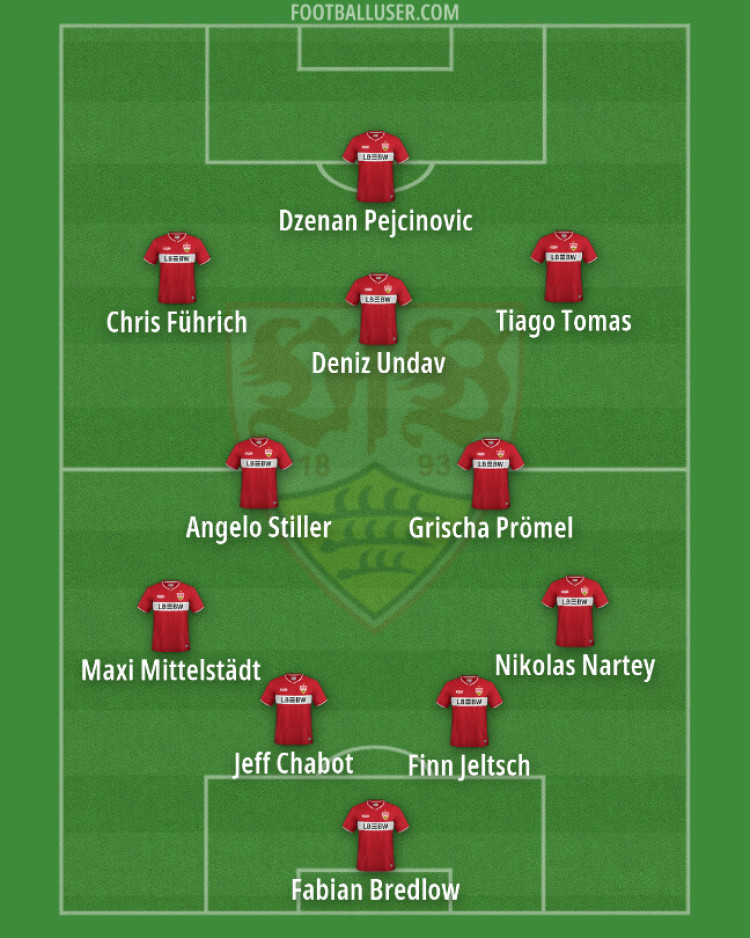
Hoeneß began exactly where the summer suggested he might. Nartey worked at right-back. Stiller and Prömel alternated their buildup responsibilities. Undav dropped away from the opposition defence and Pejcinovic remained higher. Pejcinovic scored three times. The 4-0 result mattered less than the confirmation that Hoeneß could field a genuine striker without asking Undav to abandon the spaces in which he does his best work.
Then Nartey got hurt after nine minutes.
Everything began changing remarkably quickly.
Bayern Munich 5-1 Stuttgart
Hoeneß’ first league lineup immediately looked different.
Lineup—VfB Stuttgart (Match One)
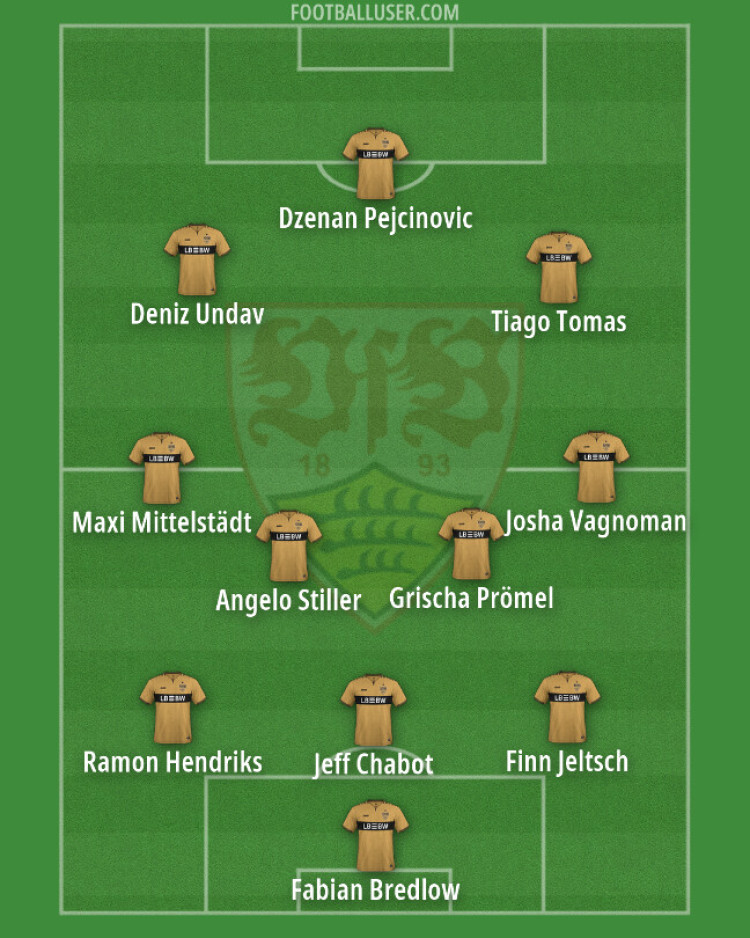
Calling this a straightforward back three still undersells the opening approach. Stuttgart defended extremely aggressively man-to-man. Chabot’s assignment on Harry Kane became the clearest example. The centre-back followed Kane absurd distances, at times almost all the way back towards Bayern’s penalty area.
The formal defensive line consequently disappeared depending on where the individual assignments took players. In possession, the three-/five-man structure became much clearer. For about 15 minutes, all of this looked clever.
Bayern struggled to settle. Stuttgart attacked bravely and Tiago Tomás struck the crossbar after 12 minutes. The champions’ first genuinely dangerous moment came from Michael Olise’s free kick against the woodwork shortly thereafter.
Then Bayern began escaping the first pressure. That changed everything. Once the hosts beat Stuttgart’s initial man-oriented assignments, enormous spaces appeared behind them. Bredlow repeatedly intervened before half-time. Dayot Upamecano’s opener arrived from a corner, but the territorial shift was already obvious.
Stuttgart nevertheless equalised shortly after the restart. Chabot attacked a Mittelstädt cross, Tiago Tomás recycled the rebound and Vagnoman arrived from deeper space to finish. The joy lasted three minutes. Bayern responded immediately through “silent protagonist” Olise. Vagnoman then slipped while attempting to clear an Alphonso Davies ball across goal and scored at the wrong end.
The game eventually finished 5-1 with Bayern generating 4.06 xG.
One shouldn’t extrapolate too aggressively from an away fixture at the Allianz Arena.
Stuttgart 4-1 Köln
Hoeneß went back.
Lineup—VfB Stuttgart (Match Two)
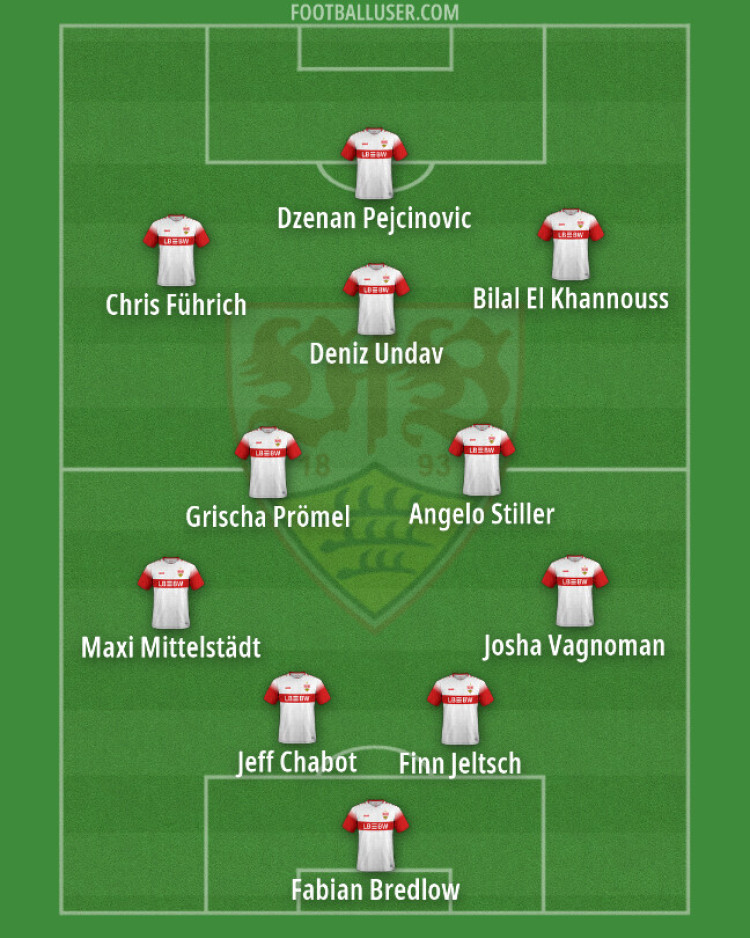
This remains Stuttgart’s cleanest attacking performance of the season. The old mechanisms returned immediately. Stiller regularly dropped between or alongside the centre-backs to organize buildup. Prömel handled more of the disruptive work before attacking higher spaces. Vagnoman and Mittelstädt pushed aggressively from their fullback positions. Führich stretched the left. El Khannouss drifted.
Köln spent most of the first half trying to locate the football. Vagnoman struck the bar from El Khannouss’ cross. Pejcinovic headed another effort against the woodwork. Undav forced Marvin Schwäbe into a save. Prömel came close. El Khannouss eventually stopped waiting for everyone else and dribbled through Köln himself. The 1-0 advantage at half-time hardly reflected a 1.84-0.17 xG difference.
Then came one of the more curious recurring features of Stuttgart’s season. They emerged from the dressing room asleep. Köln changed personnel, raised the tempo and produced several excellent chances in rapid succession. Bredlow saved efforts from new Köln introductions Ellyes Skhiri and Mikey Moore. Vagnoman blocked Ragnar Ache’s follow-up. Stuttgart suddenly looked incapable of controlling a match they had previously owned.
The response came through perhaps the prettiest collective move of the opening month. El Khannouss controlled on the left and released Mittelstädt towards the byline. The left-back cut the ball into the Rückraum. Prömel arrived completely free. 2-0. There it was. Width outside. Occupation between the lines. Fullback overlap. Late central-midfield run.
Sebastian Hoeneß football in one sequence.
The goal killed Köln’s momentum. Demirovic later added the third after an excellent individual run, and Vagnoman supplied the fourth with a preposterous stoppage-time volley. Stuttgart finished with 3.47 xG and 22 attempts. The 4-2-3-1 still worked just fine. Hoeneß nevertheless moved away from it again four days later.
Stuttgart 3-1 Viking Stavanger
Here came the first truly deliberate post-Rostock commitment to the three-man structure.
Lineup—VfB Stuttgart (UCL)
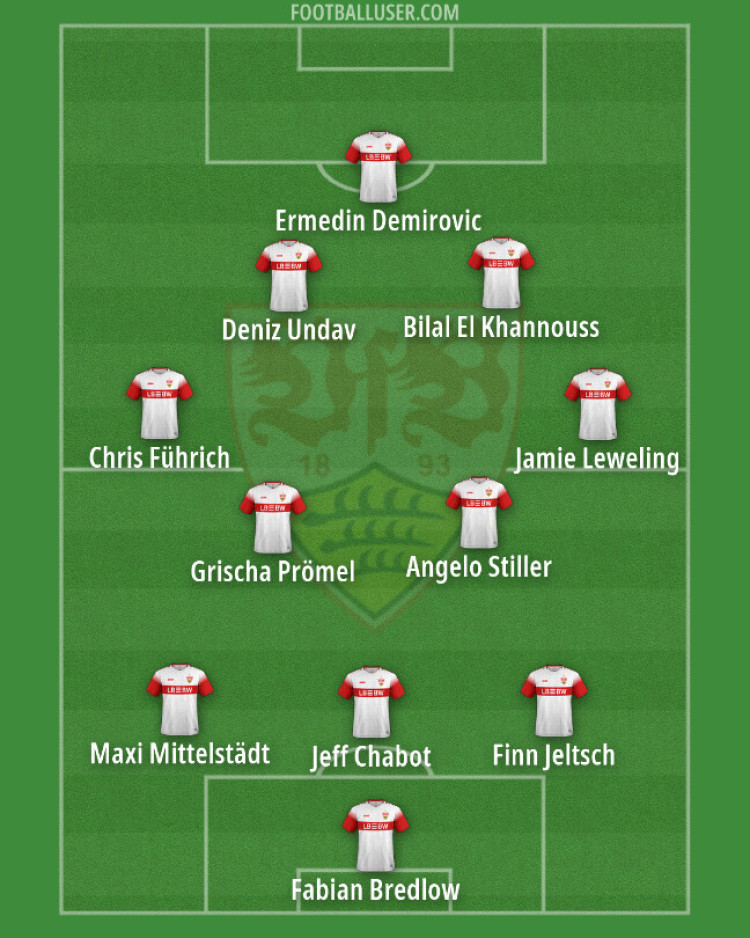
The most revealing selection was Jamie Leweling. He replaced Vagnoman and was himself replaced directly by Vagnoman after 62 minutes. Leweling was therefore not simply another conventional winger shuffled into an overloaded attack. Hoeneß used him in the aggressive right-sided wingback role.
Führich worked on the opposite side. Mittelstädt dropped into the left of the defensive three. Stavanger complicated matters early with an energetic press. Stuttgart struggled to establish clean buildup and the Norwegian champions produced the opening chances. Then Stiller ran to the byline.
The nominal central midfielder burst through the left channel and cut the ball across for Demirovic to score Stuttgart’s first proper chance. Two minutes later, Stuttgart’s defensive spacing briefly disappeared and Zlatko Tripic equalised. No matter. Undav took over.
He released Demirovic centrally for the 2-1 and supplied him again six minutes later for the hat-trick. The chemistry mattered. Undav did not need to occupy the box permanently. Demirovic did not need to come searching for every buildup touch. One interpreted the space underneath and the other attacked the goal.
Much healthier.
The second half supplied more evidence that Stuttgart still had work to do with their control. Stavanger again began brightly, found space after the restart and nearly punished a buildup error before Chabot blocked.
Stuttgart eventually settled and won comfortably. The larger tactical lesson concerned the lineup. The back three had survived Bayern and returned despite the 4-2-3-1 producing four goals against Köln. It was becoming more than an experiment.
Hoffenheim 2-1 Stuttgart
Then Hoeneß tried to fit two strikers into it.
Naturally.
Lineup—VfB Stuttgart (Match Three)
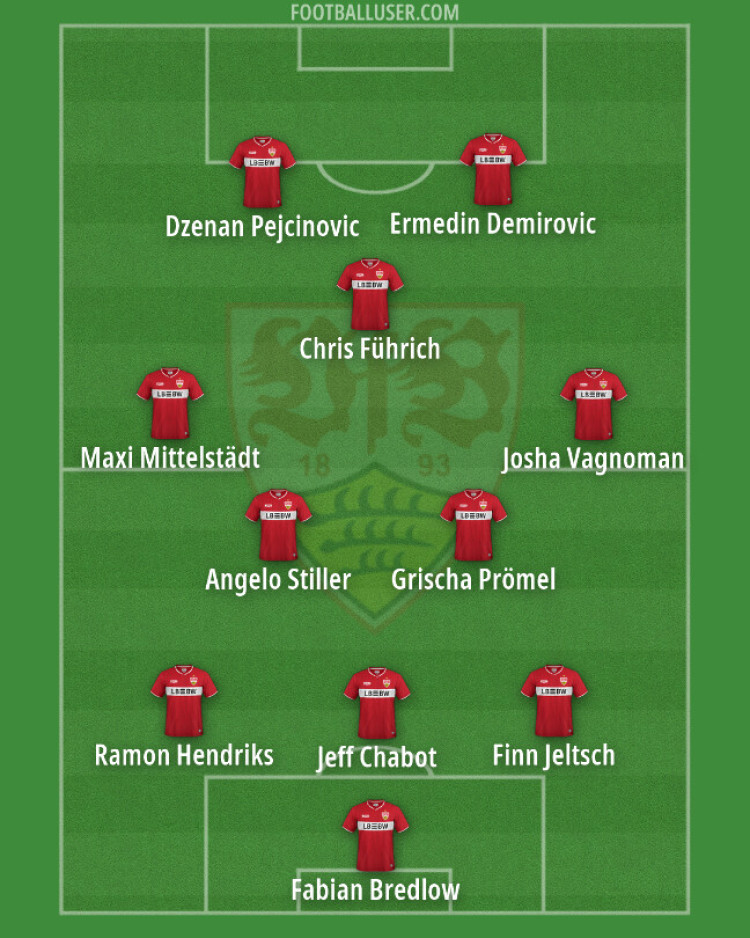
Undav dropped to the bench. Pejcinovic joined Demirovic up front. Führich worked behind them. This was probably the most aggressive version of Stuttgart’s three-man structure and, correspondingly, the version that exposed the largest problems in transition. Hoffenheim scored twice in effectively the same manner.
The first came after Stuttgart had drawn the hosts out and attempted to attack the newly opened space. Possession broke down. Bambasé Conté recovered deep and immediately sent Adam Hlozek running behind Stuttgart. 1-0.
The second came from a Pejcinovic turnover. Ozan Kabak intercepted, Adam Daghim immediately released Hlozek into the opposite channel and the Czech international ran away from Chabot. 2-1.
Mirror-image goals. Turnover. One vertical pass. Centre-back forced to defend open grass while retreating towards his own goal. This was the preseason Paris FC warning returning in competitive form. Stuttgart had created the problem themselves by committing so much attacking occupation forward without adequately securing what remained behind the ball.
The Stiller injury did not help. Yanik Spalt replaced him after 34 minutes and Stuttgart’s command of possession deteriorated further. There were plenty of chances after the break. Mittelstädt equalised after Vagnoman burst down the right. Jeltsch struck the bar. Pejcinovic forced Oliver Baumann into a superb save.
Undav entered and should have equalised when Vagnoman found him unmarked at the far post. Rather than finish, the captain attempted to square for Pejcinovic and placed the pass behind him. That sequence rather neatly captured Undav’s opening month. Stuttgart lost despite producing 2.16 xG while VAR gave Hoeneß a few extra things to gripe about.
The attack had not failed completely.
The protection behind it had.
Stuttgart 0-1 Borussia Dortmund
Hoeneß did not respond by abandoning the back three.
He refined it.
Lineup—VfB Stuttgart (Match Four)
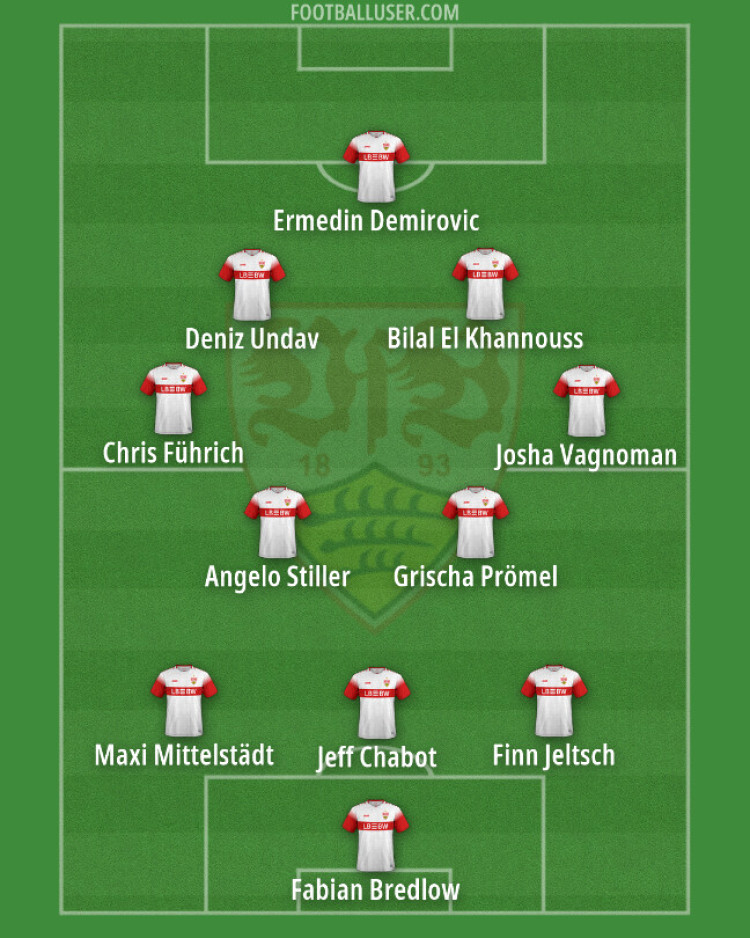
Hendriks dropped out. Mittelstädt moved into the left centre-back role. Führich became the left wingback. Pejcinovic returned to the bench and El Khannouss joined Undav underneath Demirovic. The coach explicitly spoke beforehand about connection, compactness, intensity, precision and aggression. The first two improved. This was Stuttgart’s most defensively stable back-three performance.
Dortmund produced only 1.33 xG and 13 shots. Serhou Guirassy spent most of the game isolated. Chabot controlled the central spaces well. Jeltsch defended aggressively on the right and remained secure in buildup. The wingbacks did not abandon their attacking responsibilities either. Vagnoman repeatedly drove forward. Führich held the left side and defended diligently.
The problem shifted. Stuttgart could not execute the final action. Demirovic failed to exploit one Dortmund buildup error. Undav hurried another finish. El Khannouss headed the best first-half opportunity narrowly wide. Promising switches and crosses repeatedly arrived half a metre too far forward, behind the runner or directly into a defender.
Hoeneß later highlighted precisely this decision-making problem. The clearest chance came after 59 minutes. Undav finally found the right action and split Dortmund with a through ball into Vagnoman’s run. Gregor Kobel saved. Eleven minutes later, Dortmund demonstrated the difference. Jobe Bellingham moved the ball into the space behind Chabot. Maximilian Beier escaped Jeltsch’s tracking and met the delivery from close range.
0-1.
Stuttgart kept pushing but never equalised. The defeat nevertheless represented progress of a particular sort. At Hoffenheim, the back three attacked too aggressively and left the rest defence vulnerable. Against Dortmund, the distances were significantly better and one of the Bundesliga’s strongest attacks created relatively little. Hoeneß had found more stability.
The price, at least on this evening, was considerably less attacking clarity.
Upcoming fixtures and assessment, Stuttgart
Saturday, October 10 – SC Paderborn 07 (A)
The international break gives Hoeneß plenty of time to continue working on the new back-three structures and, perhaps more urgently, the Stiller-Prömel partnership. Paderborn away also represents precisely the sort of league fixture Stuttgart now need to win. The difficult-opening-schedule defence no longer applies.
Wednesday, October 14 – Slovan Bratislava (A)
A second consecutive away fixture takes Stuttgart to Slovakia in the Champions League. Victory over Stavanger already supplied the desired European start. Slovan offers an opportunity to build upon it before Atlético Madrid visit the MHP-Arena six days later.
Saturday, October 17 – Hamburger SV (A)
Another away fixture? The Bundesliga computers have some explaining to do! Three points from four league fixtures may be explainable when Bayern and Dortmund account for half the schedule. The same generosity will not extend indefinitely. Paderborn and HSV represent the sort of opposition against whom Stuttgart’s superior individual quality must begin translating into superior results.
The underlying football still supplies considerably less cause for alarm than the table. Hoeneß has already improved the defensive compactness of the three-man shape since Hoffenheim. Vagnoman and Mittelstädt provide plenty from the wide areas. El Khannouss looks sharp. Demirovic has won the first round of the striker competition.
There remains work to do.
The Stiller-Prömel partnership needs better spacing and cleaner second-ball control. Undav needs rhythm and, ideally, a cooperative Achilles tendon. The attack needs better decisions against compact defensive blocks. Most importantly, Stuttgart must learn how many bodies they can throw forward before the centre-backs are left defending several hectares of Baden-Württemberg by themselves.
The Dortmund performance suggested progress. Now come the points. As any good EnBW engineer will remind you, there is no need to test the emergency sirens. This is Swabia, after all. One does not waste perfectly good electricity before it becomes absolutely necessary.
The house must be placed in order ahead of Paderborn and Hamburg. As any good Swabian landlady will remind you, “Kehrwoche” accords one the chance to take personal pride and pleasure in sweeping and mopping the common area.
Hoeneß gets a double “Kehrwoche” thanks to this new international break format.
Undav, Prömel, Stiller, and several others have extra time to make those floors sparkle.
One expects nothing short of immaculate brilliance once play resumes.
Comment / Reply From
You May Also Like