


Leeds United vs Manchester United Preview: Prediction, Probable Lineups, Tactics, Team News & Stats
Leeds United vs Manchester United at Elland Road on Sunday will be a battle between a high-flying minnow and a struggling giant.
Leeds United’s competitive 2-1 defeat at Arsenal left them encouraged rather than shaken, while Manchester United’s midweek loss to Atletico Madrid deepened the sense that their season is already demanding a response.
The hosts have not lost a Premier League home match at Elland Road in seven games, and Manchester United have won only once in the league this season. That makes this a meaningful fixture. Leeds are trying to protect a strong start, while the Red Devils need points to keep their higher ambitions alive without allowing another setback to widen the pressure around Michael Carrick.
For Leeds, a win would strengthen their position near the European places and keep the UEFA Champions League spots within reach. A draw would preserve momentum, but defeat would make the Arsenal loss more costly and halt a chance to build on their home platform. They carry a settled managerial environment and the confidence of having competed well at the Emirates, even though the result went against them.
Their recent run is represented by two wins, three draws, and one defeat across six Premier League matches. The only selection issue that could alter the balance is Daniel James’s back problem. The Welsh winger has returned to training, and any involvement would give Leeds another wide option without changing the main argument for their established shape.
Manchester United, on the other hand, need the win to keep their get away from their crisis, though the early stage of the season means the result is important rather than decisive. Another defeat would leave them stuck in the middle of the table and intensify scrutiny after the loss to Atletico Madrid and the draw with Tottenham, when they failed to protect a numerical advantage.
Their recent league sequence contains one win from six, and the team arrives with defensive vulnerability hanging over an attack that has not converted its pressure consistently enough. The task is therefore different from Leeds United’s: Carrick’s men must pursue three points, but cannot afford to turn the match into another uncontrolled contest on Sunday.
Team News: The predicted sides and the choices behind them
Joe Rodon is out for Leeds United with a hamstring injury, while Mateo Joseph remains unavailable after a cruciate ligament tear. Daniel James is doubtful, having resumed training after recovering from a back injury. Rodon’s absence removes a central defensive option. So, Leeds are expected to retain the three-man cover built around Nico Elvedi, Tarik Muharemovic, and James Justin.
James Trafford should take his place in goal, with Gabriel Gudmundsson and Jayden Bogle providing the width from the wing-back spots. Trafford has been ever present between the sticks and carries a 7.21 average rating, providing a solid presence between the sticks.
As for the midfield unit, Ethan Ampadu is expected to sit in front of the back three, with Ao Tanaka and Anton Stach alongside him. Stach has one goal, seven key passes and a 7.14 rating, although Ampadu’s deeper positioning remains the key to keeping the structure balanced.
Dominic Calvert-Lewin should lead the line for Leeds United vs Manchester United, with Noah Okafor completing the front two. Calvert-Lewin has two goals and one assist from six starts, with seven of eleven shots on target, and remains the central reference for the hime side’s attacks. The front pair gives Leeds a fixed target and a mobile runner, while the wing-backs can advance without leaving the whole attack dependent on one striker.
Probable Leeds United Starting Lineup (3-5-2): Trafford; Justin, Elvedi, Muharemovic; Bogle, Stach, Ampadu, Tanaka, Gudmundsson; Calvert-Lewin, Okafor

Probable Manchester United Starting Lineup (4-2-3-1): Lammens; Dalot, Maguire, Martinez, Shw; Tielemans, Mainoo; Amad, Bruno Fernandes, Cunha; Mbeumo
Manchester United have Manuel Ugarte out with a cruciate ligament tear. That leaves Kobbie Mainoo and Youri Tielemans as the expected double pivot, though Mainoo’s availability remains uncertain. Meanwhile, Patrick Dorgu (hamstring) and Benjamin Sesko (shin) are the other notable absentees, while Michael Carrick will take a late call on the involvement of Luke Shaw and Noussair Mazraoui.
The back four should feature Luke Shaw, Lisandro Martinez, Harry Maguire, and Diogo Dalot, with Martinez settling into the team despite his midweek outburst and the subsequent speculation. Senne Lammens is expected to continue in goal, with Manchester United lining up in a 4-2-3-1 formation vs Leeds United.
Ahead of the pivot, Bruno Fernandes should operate centrally, with Matheus Cunha to his left, Amad Diallo to his right, and Bryan Mbeumo up front. Fernandes has three goals, one assist, and 15 key passes, while Amad has three goals and eleven key passes. Mbeumo has contributed one goal, two assists and three big chances created. The attacking players must create enough threat to stop Leeds United’s back three from defending comfortably.
Tactics: Leeds United’s pressure vs Manchester United’s controlled shape
Leeds United are expected to use a 3-5-2 formation that preserves two forwards, keeps three defenders behind the ball and allows both wing-backs to push high. They are not a possession-dominant side by habit. The Whites average 46% of the ball against a league norm of 48%, while Manchester United average 56% on the same comparison.
Michael Carrick’s men therefore tend to establish more of the game through possession, but the home side’s plan is to make each contest uncomfortable rather than wait passively. Leeds also play more directly than United. Their long-ball figure is 52.5 per match against a league-typical figure of 49.75, while the Red Devils are at 43 against that same reference point.
That should bring Dominic Calvert-Lewin into the game early and give Noah Okafor second-ball situations around him. Leeds’s measured shooting volume is modest, at 12 attempts against the league norm of 12.5, whereas Manchester United reach 18.5 against the same typical figure. The home side’s front-foot approach must therefore turn pressure into territory and recoveries, not simply possession for its own sake.
The physical difference is clearer in the contest profile. Leeds produce 106.5 combined ground and aerial contests per match against a league typical 95.75, while Manchester United sit at 87, partly contributing to their struggles this season.
That suits a home plan built around duels, second balls, and the two-forward reference point. Manchester United’s 4-2-3-1 setup is designed to seek the win while still accepting a draw. So, their double pivot and back four should try to keep the central lanes orderly. Leeds, by contrast, are likely to carry the match forward within their shape and accept some exposure behind the wing-backs. The central duel is Dominic Calvert-Lewin against Harry Maguire.
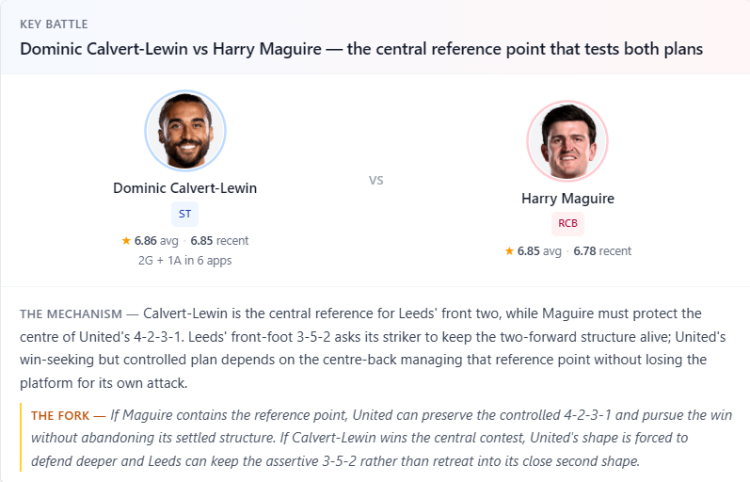
Calvert-Lewin gives Leeds a target who can keep the front two connected, while Maguire is the defender responsible for stopping that reference point from turning every direct pass into a platform. The former Manchester United captain enters the contest in stronger recent form, but Calvert-Lewin’s steady output and physical role matter more than a single finishing moment.
If Maguire contains him, Manchester United can maintain the controlled 4-2-3-1 and attack through Bruno Fernandes between the Leeds midfield and back line. If Calvert-Lewin wins the battle, the visitors will be forced deeper, Leeds can keep their aggressive three-man structure, and the pressure will build around the visitors’ penalty area.
The wider contest adds a second route to the same problem. Jayden Bogle is expected to stretch Manchester United’s left side, where Luke Shaw must stop the wing-back from creating a free crossing or cutback lane. If the veteran defender holds that flank, Manchester United can keep their shape compact and Leeds lose some of the width needed to pull the block apart.
If Bogle breaks through, the away side will have to widen their defensive structure and concede more territory. Leeds United’s higher duel profile also gives them a chance to sustain attacks after the first challenge rather than treating each forward move as a single delivery.
Dead balls may keep the match close even if one side controls open play. Leeds generate 0.3135 xG per match from set pieces against a league typical 0.262, while Manchester United produce 0.3105 against the same figure. Both sides have a route to punish a defensive lapse, and that matters because the home side’s assertive wing-back positioning could create fouls while Manchester United’s controlled approach may rely on defending their box for long periods.
Prediction: Leeds have enough to edge a tight contest
We predict a Leeds home win, albeit only with medium confidence. Their advantage is not simply the home setting or Manchester United’s poor run. The home side’s two-forward structure should test Manchester United’s central defenders, and their higher-volume duel profile gives them a credible way to turn territorial pressure into repeat attacks.
The Red Devils have the greater appetite for shots, but Leeds United’s recent scoring record has been almost exactly in line with their expected output, while the visitors have finished more than two goals below theirs over the season. That makes Michael Carrick’s men vulnerable to another match in which their pressure looks better than the final score.
Lean: Leeds United win
Range: 2-1/1-1/2-0
The strongest case against Leeds is that Manchester United’s central creators can bypass the physical contest. Bruno Fernandes can receive between the Leeds midfield and backline, while Amad Diallo and Bryan Mbeumo offer enough movement to pull the outside centre-backs away from Dominic Calvert-Lewin.
If the away side keep the ball away from the wing-back battles and force Leeds United’s midfield to turn toward its own goal, their higher shooting habit could become decisive. Daniel Farke’s men would then be defending the shape rather than imposing it, and the home advantage would not by itself protect them. The expected scoreline range is 2-1, 1-1 or 2-0, with Leeds the likelier of the two teams to win this game.
The change Leeds can make if the centre is blocked
Leeds have a clear in-game adjustment if Manchester United contain the front two without giving up chances. They can move from the 3-5-2 to a 3-4-2-1, placing an extra narrow attacking midfielder behind the striker.
That would give them another player between Manchester United’s pivot and centre-backs, but it would also reduce the two-forward pressure that makes the opening shape difficult to defend. The timing of that switch could decide whether Leeds sustain their initiative or allow the visitors to settle.
Comment / Reply From
You May Also Like