

Leeds United vs Crystal Palace Preview: Prediction, Probable Lineups, Tactics, Team News & Stats
Leeds United vs Crystal Palace at Elland Road on Sunday will feature two teams coming into the match on the back of big wins this week, but on the opposite end of the form spectrum in the Premier League.
Leeds United arrive at Elland Road after a 4-1 victory over Newcastle United, while Crystal Palace’s latest statement was a 4-0 UEFA Europa League win against Lech Poznan. Those results point in different directions. The hosts have carried their strong domestic start forward, whereas Palace have needed a midweek lift to interrupt a difficult league opening.
The match is meaningful for both sides. However, it is Leeds who can use home momentum to strengthen an already encouraging campaign while Palace need to turn relief into league substance. For the home side, the value lies in extending an unbeaten Premier League start and keeping the confidence around Daniel Farke’s side intact.
A draw would preserve progress but surrender the chance to press their advantage at home; defeat would make the early optimism less secure. Their recent league record has been particularly durable, with only one loss in their past 12 matches since mid-March.
The back-three switch made last winter remains part of that stability, and the win over Newcastle showed a side comfortable carrying authority into a high-profile fixture. They bring a settled managerial project and a clear opportunity to make Palace defend for long periods.
On the other hand, Crystal Palace approach the game from a less comfortable domestic position. Their European result offered genuine encouragement, but three defeats in their first four Premier League matches mean another setback would leave the new Pierre Sage era with more questions than answers.
A win would give the attacking shift something tangible to build around, while a draw would at least halt the slide without fully solving the defensive concerns. Palace have shown enough going forward to threaten Leeds, yet the task is to transfer the European performance into a league match against a home side that is already functioning with greater continuity.
Team News: The confirmed elevens and the absences behind them
Leeds United are without Joe Rodon, Mateo Joseph, and Harry Wilson. Rodon’s hamstring injury removes a centre-back option, Joseph’s cruciate ligament injury reduces the forward depth, and Wilson’s quad problem takes away another attacking choice. None of those absences changes the selected structure as sharply as the loss of a holding midfielder would, but they leave the XI relying on its established core.
James Trafford starts in goal, with James Justin, Nico Elvedi, and Tarik Muharemovic forming the back three. Muharemovic has started all four of his appearances, and he has supplied one assist, while Justin has contributed three key passes across his four starts.
As for the midfield unit, Ethan Ampadu sits in front of the defence, with Ao Tanaka and Anton Stach completing the central midfield trifecta. Ampadu has started all four Premier League games and has supplied three key passes, but the holding role will ask more of him defensively than those figures suggest.
Tanaka has one assist in three appearances, while Stach has scored once and delivered five key passes in four matches. Gabriel Gudmundsson and Jayden Bogle provide the width, and the latter’s return of two goals from four starts makes him more than a provider of defensive balance. Dominic Calvert-Lewin and Noah Okafor lead the attack; Calvert-Lewin has two goals and one assist, while Okafor has scored once.
The expected Leeds formation is 3-5-2. It is not a sudden experiment, as they have divided their recent use between that shape and 3-4-2-1. So, the selection reflects a balance Leeds already know. The three-man midfield is the important call, giving Ampadu protection and leaving Stach and Tanaka close enough to support the front two. Trafford and Muharemovic are particularly important to the defensive platform, while Calvert-Lewin remains the central reference point.
Probable Leeds United Lineup (3-5-2): Trafford; Justin, Elvedi, Muharemovic; Bogle, Stach, Ampadu, Tanaka, Gudmundsson; Calvert-Lewin, Okafor
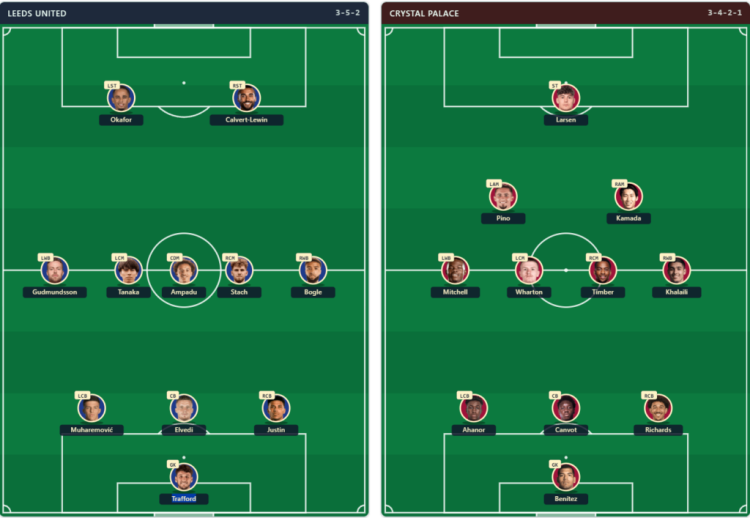
Probable Crystal Palace Lineup (3-4-2-1): Benitez; Richards, Tomiyasu, Ahanor; Khalaili, Timber, Wharton, Mitchell; Kamacha, Pino; Strand Larsen
Pierre Sage is without Jean-Philippe Mateta and Chadi Riad, with Mateta missing through a hamstring injury and Riad recovering from knee surgery. Ismaïla Sarr is doubtful with a groin injury and may only be able to appear briefly, while Dean Henderson is also doubtful as he works back from injury.
Sarr’s uncertainty limits the attacking alternatives around the striker, and Henderson’s doubt affects the goalkeeping decision rather than the outfield structure. Walter Benitez is therefore expected to start, behind Chris Richards, Jaydee Canvot, and Honest Ahanor.
Tyrick Mitchell and Anan Khalaili should operate as the wing-backs, with Adam Wharton and Quinten Timber in the middle. Mitchell has two goals and five key passes in four starts, while Timber has started twice and carries a recent attacking lift into the midfield contest.
Daichi Kamada has supplied three assists and six key passes from four appearances, making him the more productive of Palace’s two narrow connectors. Yeremy Pino should take the role on the other side, with Jorgen Strand Larsen leading the line. The Norwegian striker has three shots on target from five attempts and is also Palace’s penalty taker.
The Eagles are expected to use 3-4-2-1, their regular recent choice, having selected it in four of their last five matches. The 3-4-3 remains the alternative if they decide that occupying all three Leeds centre-backs is more important than keeping two narrow creators behind Strand Larsen.
Tactics: Leeds United’s second balls against Crystal Palace’s narrow platform
Leeds United’s 3-5-2 setup is designed to put three midfielders behind two strikers, allowing the home side to carry the game forward without abandoning the back three. Their measured profile supports a direct route over midfield. The Whites play 52.5 long balls per match against a league-typical figure of 50, while the away side play 39 against that same mark.
The gap matters because the two sides are not trying to arrive in the same way. Leeds can bypass the first pressure and compete for the next ball; Palace are more likely to defend the first pass and then fight for the loose one. The away side’s identity is more physical in the immediate challenge.
They make 21.5 tackles per match compared with the league’s typical figure of 15, which suits a match where they may have to interrupt Leeds United’s forward movement repeatedly. Their 3-4-2-1 system keeps two narrow attackers connected to Jorgen Strand Larsen while retaining four players behind the midfield line.
It gives Palace a route to threaten centrally, but it also leaves Adam Wharton and Quinten Timber responsible for a large amount of space against the home side’s extra midfielder. The Eagles want to win without treating a draw as failure. So, they should attack when the openings appear while becoming more conservative if the game begins to run away from them. Possession is unlikely to define the contest by itself.
Leeds have averaged 44% of the ball across their recent run and Palace have also averaged 44%, both just below the league-typical figure of 46%. The more important difference is what each side does when the ball leaves the first phase. The home side’s front-foot approach asks them to send the game forward and keep the second-ball zone occupied.
Palace’s approach asks them to remain connected enough to counter that pressure without opening the space their recent league defending has struggled to protect. The main contest is Ethan Ampadu against Quinten Timber.
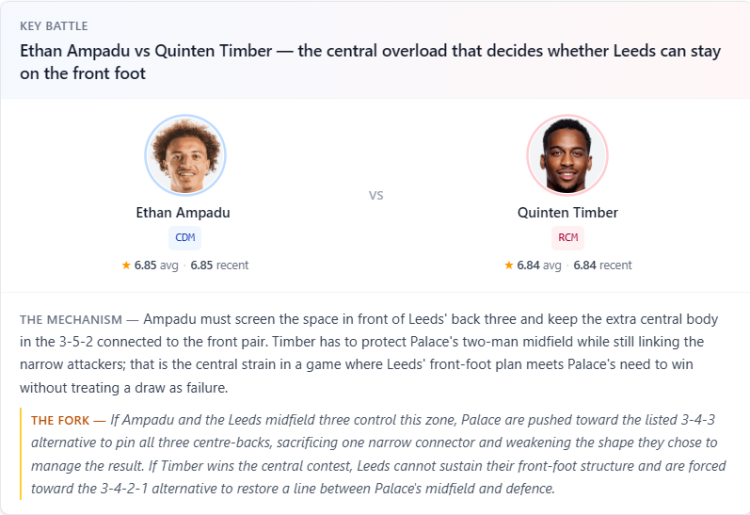
Ampadu has to screen the space in front of Leeds United’s back three while remaining close enough to the other two midfielders for the 3-5-2 setup to stay compact. Timber has to protect a two-man midfield and still connect Kamada and Pino to Strand Larsen. The Dutchman’s recent form gives Palace the more forceful individual case in that zone, but Ampadu has an extra central body beside him.
If Ampadu and Leeds control the loose balls, the visitors may have to switch to 3-4-3, sacrificing one narrow connector to pin the three centre-backs. If Timber wins the contest, the home side may need 3-4-2-1 themselves to add a player between Palace’s midfield and defence and restore a reliable attacking connection.
Jayden Bogle and Tyrick Mitchell provide the second important battle. Bogle must give Leeds width without becoming detached from the midfield unit, while Mitchell has to advance for Crystal Palace without exposing the back line behind the narrow attackers.
If Bogle holds that wide route, Palace’s two inside players can be squeezed toward the centre. If Mitchell controls his side, Leeds United’s 3-5-2 risks losing the width that makes its central overload useful. The match should therefore be shaped by the central duel, but not decided by it alone: the wing-backs determine whether either midfield advantage can become sustained pressure.
Prediction: The home win is the clearer side, but not a runaway call
We are leaning towards a Leeds United win with medium confidence. The strongest reason is structural rather than emotional. The Whites have three central midfielders supporting their direct route, while Crystal Palace have two central players trying to protect the defence and feed two narrow attackers.
If the hosts win enough second balls, it can keep Dominic Calvert-Lewin and Noah Okafor supplied without exposing Ampadu to every transition alone. Leeds also bring the stronger recent defensive base. They have conceded an average of 1.47 expected goals per match across their four Premier League outings, compared with Palace’s 2.05 across their Premier League and UEFA Europa League runs.
Both sides have recorded one clean sheet in those respective runs, so this is not a case for expecting the away side to collapse every time Leeds attack. It is instead a reason to prefer the home side in a match where the first goal could determine which team is able to keep its intended shape.
The strongest case against Leeds is Palace’s progression through Quinten Timber. If he wins the central contest, the visitors can connect Daichi Kamada and Yeremy Pino to Jorgen Strand Larsen early, forcing Leeds United’s midfield to turn towards its own goal.
That would prevent Leeds from sustaining the pressure their extra midfielder is supposed to create and could expose the spaces around the outside centre-backs. Crystal Palace’s European win showed that the new attacking approach can produce a sharp response; the danger is that a similar start here makes Leeds defend rather than impose.
The likely scoreline range is 2-1, 2-0 or 1-1. Leeds United are the better match-result side, but Crystal Palace have enough attacking access to make the draw a credible live outcome if the first central exchanges go their way.
The shape change that could redraw the final half-hour
The clearest in-game lever belongs to Leeds United. If Crystal Palace’s narrow attacking pair begins to block the central route, the Whites can move to 3-4-2-1 and add a higher line between midfield and defence rather than simply sending more direct balls forward.
Pierre Sage’s men have their own response in 3-4-3, but that change removes one of the connectors that makes their chosen shape useful. The side that adjusts without losing its central cover should control the final phase.
Comment / Reply From
You May Also Like