

Fulham vs Manchester United Preview: Prediction, Probable Lineups, Tactics, Team News & Stats
Fulham vs Manchester United at Old Trafford will feature two teams desperate to secure a Premier League win after a slow start to the 2026/27 season.
Manchester United’s collapse from 2-0 ahead to a 3-2 defeat to Brighton & Hove Albion in the EFL Cup third round has dampened the mood around this visit to Craven Cottage, while Fulham followed a 0-0 draw at Anfield with a 3-2 cup win over West Ham United. This is an early-season meeting between two sides needing a reset, but the consequences are not identical.
Fulham need a lift from 19th, whereas Manchester United need a result to stop their top-four ambitions drifting further away. A win would be meaningful for both without making the season decisive. The home side’s immediate objective is to turn the Anfield resilience into a home victory.
Alvaro Arbeloa’s charges have one point from their opening four league games, and another failure to win would leave them stuck among the poorest starters, even though a victory would lift them just outside the drop zone.
The draw at Liverpool showed that the West London outfit can protect a result against stronger opposition, while the win over West Ham offered evidence that their young attackers can produce more. They carry a settled plan into this match, but their recent run means they cannot afford another afternoon in which promising possession produces too little.
Manchester United arrive with more attacking encouragement beneath an unstable sequence. They have won only one of their first four Premier League games, sit 13th, and were beaten by ten-man Manchester City last weekend before the Brighton reversal added another warning.
A victory here would move them into the top half of the Premier League table rather than instantly repair the table. So, the need is significant rather than absolute. Michael Carrick’s men are under pressure to provide answers, and the away draw is still useful if the match refuses to open up.
Team News: The predicted elevens and the questions around them
Fulham have three players unavailable. Tom Cairney is out after knee surgery, Kenny Tete is recovering from a concussion, and Ryan Sessegnon is doubtful as he works towards a selection decision. Cairney’s absence leaves the double pivot to provide the central balance, while Tete’s absence keeps Timothy Castagne as the expected right-back. Sessegnon’s situation concerns the wider defensive options rather than the projected starting structure.
The home side should use the familiar 4-2-3-1 setup, with Bernd Leno behind a back four of Antonee Robinson, Calvin Bassey, Joachim Andersen, and Castagne. Robinson has supplied five key passes in four appearances and has been one of Fulham’s more reliable progressors from the left. Bassey has started all four matches and carries a 6.72 average rating.
Alex Iwobi is probable beside Sander Berge, although his selection carries more weight because he is the connector in the pivot. The Nigerian international has five key passes and one big chance created despite a 6.91 rating.
Josh King remains the attacking hinge, with two goals, four key passes and five shots on target from eleven attempts. Cesar Palacios should join Oscar Bobb behind Gonzalo García, who has started every match and scored once, though only two of his twelve shots have been on target.
Probable Fulham Lineup (4-2-3-1): Leno; Castagne, Andersen, Bassey, Robinson; Berge, Iwobi; Bobb, King, Palacios; Garcia
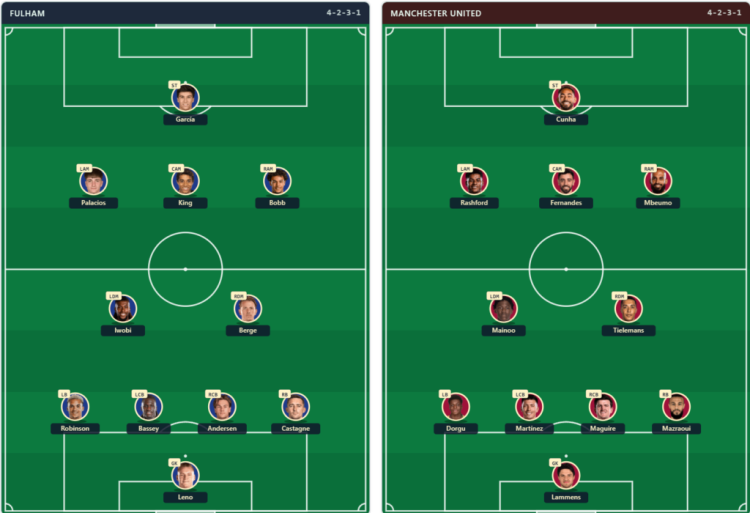
Probable Manchester United Lineup (4-2-3-1): Lammens; Mazraoui, Maguire, Martinez, Dorgu; Tielemans, Mainoo; Mbeumo, Bruno Fernandes, Rashford; Cunha
Manchester United have Manuel Ugarte and Amad Diallo out, while Benjamin Sesko remains a doubt with a knee issue. Luke Shaw and Carlos Baleba are also doubtful. Sesko’s status matters most to the forward line, but the predicted selection keeps Matheus Cunha as the central reference rather than changing the structure.
Senne Lammens should start behind Patrick Dorgu, Lisandro Martínez, Harry Maguire, and Noussair Mazraoui, though Luke Shaw could start if he is fully fit. As for the midfield unit, Kobbie Mainoo and Youri Tielemans form the expected double pivot; Mainoo has one assist and five key passes, and Tielemans has six key passes with three shots on target from six attempts.
Bruno Fernandes is the clear creative centre of the team, with three goals, one assist. and nine key passes, while Bryan Mbeumo brings two goals and seven key passes from the right flank. Marcus Rashford is expected on the left wing, though that call is less secure than the rest of the attacking group.
Tactics: A direct Fulham route against United’s controlled possession
Both teams should keep line up in a similar setup, but they will use differently. Fulham are expected to carry the match towards United while keeping two midfielders behind King, allowing Gonzalo Garcia to provide a central target and Cesar Palacios to operate between the lines.
Manchester United should also seek the win, but their structure gives them permission to accept a draw rather than turn the match into an open chase. Bruno Fernandes can stay behind Matheus Cunha, with Kobbie Mainoo and Youri Tielemans protecting the centre. The varying profiles show that both sides are comfortable having the ball.
Fulham average 59.5% possession and Manchester United 57.5%, compared with a league typical of 46.5%. That does not guarantee control for either side here, because Fulham’s possession is paired with a more direct route. The Cottagers produce 54.5 long balls per match against the league’s average of 50, while Manchester United are at 40 against the same figure.
The meeting point is therefore likely to be central. Garcia trying to make those deliveries useful, Harry Maguire defending the first contact, and King looking for the loose ball behind them. Fulham’s home approach carries more risk because their shape asks them to use territory rather than wait for the match to come to them. United can be more selective.
Their recent profile points to an attacking side that shoots frequently, but the defeat to City showed how quickly that threat can disappear when the opponent denies access to the final third. The key system question is whether Fulham’s two midfielders can keep enough cover behind Joshua King and Garcia when they push forward, or whether United’s patient circulation draws them out and feeds Fernandes between the lines.
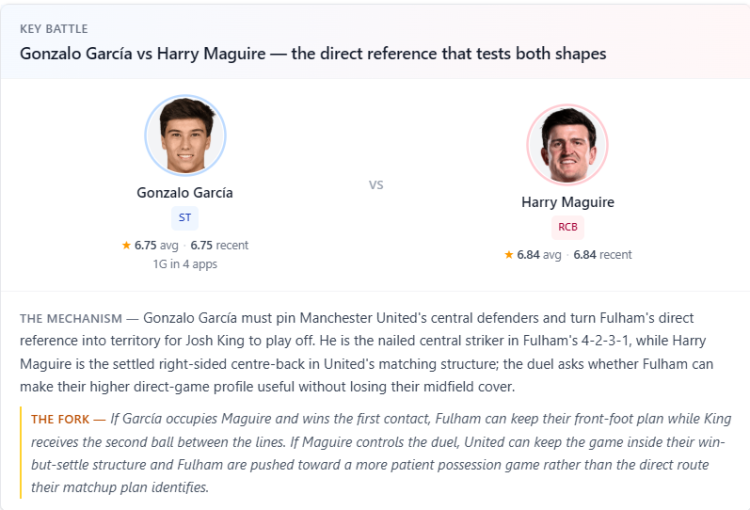
The primary duel is Garcia against Maguire. The Spaniard has to occupy the centre-backs and turn the first ball into territory; Maguire’s job is to control that contact and stop Fulham from building attacks through King.
Garcia’s recent finishing has been uneven, with one goal from four starts, while Maguire has been a regular presence in a defence that Manchester United will want to keep intact. If Garcia wins the first contact, King can receive the second ball and Fulham can sustain their assertive plan. If Maguire controls it, the visitors can keep the game inside their measured approach, forcing Fulham towards shorter possession instead of the direct route they want.
The other important collision is on Fulham’s right, where Timothy Castagne must deal with Marcus Rashford while still giving Oscar Bobb a platform ahead of him. If the former is pushed too deep, Fulham lose territory and their wide outlet; if he holds his position, Rashford has less room to turn the home side’s pressure into a retreat. That is a different mechanism from the central duel, because it concerns whether Fulham can keep the width needed to support their front-foot plan.
Prediction: United have the stronger numbers, but not a banker’s case
We are leaning towards a Manchester United win, held with medium confidence rather than conviction. Their recent attacking and defensive balance is the clearest separator. The away side average 2.31 expected goals per match, compared with Fulham’s 1.63. United also concede 0.88 expected goals per game, while Fulham have let in 1.36.
Those figures point to the visitors creating the better chances and giving up less, even if their results have not consistently reflected it. Manchester United’s shot volume strengthens that case. They average 18.5 attempts per match against a league typical of 12, although that measured habit comes from only the recent four-match window and their league output has not always matched it.
Lean: Manchester United win
Range: 1-2/0-1/1-3
Their 0-1 defeat to Manchester City, when they managed only six shots, is the strongest warning against treating the attacking numbers as automatic goals. Fulham can make this difficult if Gonzalo Garcia wins enough first contacts, King gathers the second balls and the home side keeps United from converting possession into clean looks.
That is the strongest argument against the prediction. Fulham’s direct pressure can turn the match into a series of uncomfortable central contests, while Manchester United’s willingness to bank a draw may allow the hosts to stay in the game. Still, the visitors have the clearer route to control the decisive areas and should find enough attacking moments to edge it. The most plausible scoreline range is 1-2, with 0-1 and 1-3 also fitting the expected pattern.
The unsettled left side could still alter the balance
The remaining selection question on Manchester United’s left may change the way their controlled plan functions. A more secure wide combination would help them keep Fulham’s right side pinned and reduce the need for Bruno Fernandes to solve every attacking phase centrally; a late change there would ask the visitors to adjust their support around Matheus Cunha. That is the small detail capable of turning a narrow United advantage into a more even contest.
Comment / Reply From
You May Also Like