

Newcastle United vs Hull City Preview: Prediction, Probable Lineups, Tactics, Team News & Stats
Newcastle United vs Hull City at St. James’ Park will feature two teams on the opposite end of the form spectrum, though both sides will be eager to return to winning ways on Saturday.
Newcastle United’s unbeaten start to the 2026/27 season ended with a damaging 4-1 defeat at Leeds United on Monday. The game exposed how quickly their structure can become vulnerable when the game turned against them. Hull City now arrive at St. James’ Park unbeaten, newly promoted and already occupying a Champions League spot.
This is Newcastle’s chance to answer that setback, but Hull’s early-season platform makes a draw a useful outcome for the visitors rather than a failure. For the home side, a win would move them into the immediate top-four range and give Matthias Jaissle the reaction he has demanded.
A draw would at least stop the Leeds defeat signalling the start of a slide, while a loss would leave the pressure around their defensive vulnerability and response under scrutiny. The match matters in the wider Champions League race, but it is still too early for either side to treat the result as decisive.
Newcastle carry a mixed run into the game: one win, two draws, and a defeat from their opening four Premier League matches. Their last outing was the collapse at Leeds, and the priority now is to restore control without turning the response into another open chase. The familiar structure should help, although a number of absences have altered the personnel around it and reduced the margin for mistakes.
Meanwhile, Hull’s position is different. They have taken eight points from four matches and remain unbeaten after drawing with Chelsea, a result manager Sergej Jakirovic viewed as evidence of the team’s resilience. The Tigers do not need to force Newcastle into a high-risk game. That gives the visitors the opportunity to defend patiently and wait for the moments when the home side overcommits.
Team News: Newcastle reshuffle around the same attacking framework
Newcastle United are without Dan Burn, Joelinton, William Osula, Anthony Elanga, Amar Dedic, Nico Gonzalez, and Jacob Ramsey. Dedic’s injury places Tino Livramento at right-back. Elanga’s unavailability shifts Harvey Barnes across to the right, and Gonzalez’s absence is reflected in the decision to retain two central midfielders behind the attacking three rather than rebuild the system.
The home side should line up in their established 4-2-3-1 setup. Lukas Hornicek remains the goalkeeper behind a back four of Lewis Hall, Sven Botman, Malick Thiaw, and Livramento. Hall has started four matches and supplied four key passes, so his role is more than defensive. The Englishman is expected to provide the width that allows the left-sided attack to move inside.
As for the midfield unit, Lewis Miley and Sean Steur should form the double pivot. Miley has made four starts and supplied three key passes, giving Newcastle a reliable link from the base of midfield, while Steur provides the cover needed behind Joe Willock, Bazoumana Toure, Barnes, and Yoane Wissa.
Joe Willock should operate centrally after contributing two key passes and creating one big chance in his four appearances. Toure keeps the other attacking lane, and Wissa leads the line after registering one goal, one assist and four key passes.
Probable Newcastle United Lineup (4-2-3-1): Hornicek; Livramento, Thiaw, Botman, Hall; Steur, Miley; Barnes, Fernandez-Pardo, Toure; Wissa
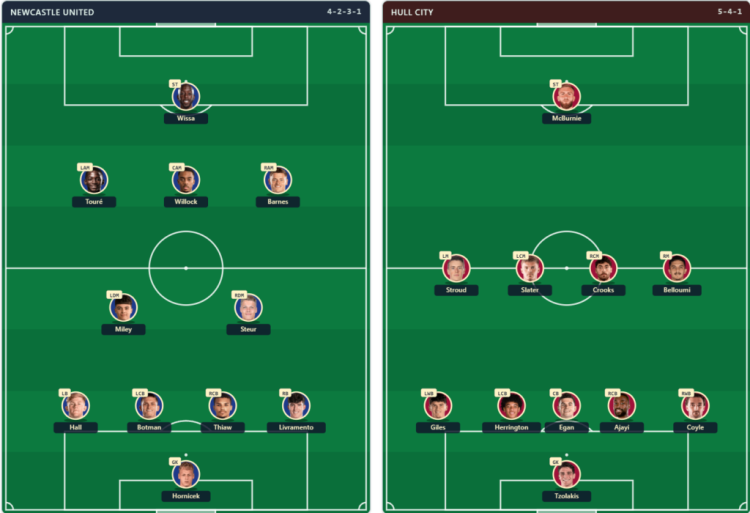
Probable Hull City Lineup (5-4-1): Tzolakis; Coyle, Ajayi, Egan, Herrington, Giles; Belloumi, Slater, Crooks, Stroud; McBurnie
Meanwhile, Matt Targett is doubtful for Hull, while Abdulkadir Omur, Eliot Matazo, Joe Gelhardt, Darko Gyabi, Charlie Hughes, Jens Hjerto-Dahl, Nobel Mendi, and Ilyas Ansah are out. Hidemasa Morita is unavailable as he works back towards a return. The visitors therefore keep their settled defensive plan but have fewer alternatives if the match demands a change in the middle or at centre-forward.
Hull’s 5-4-1 setup has been a staple, and the team preserves that continuity. Konstantinos Tzolakis starts behind Lucas Herrington, John Egan, and Semi Ajayi, with Herrington deputising for Mendy. Ryan Giles and Lewie Coyle should provide the width from wing-back. Giles has six key passes and has created four big chances, making his delivery and forward running important even in a defensive setup.
As for the midfield unit, Regan Slater and Matt Crooks are expected to occupy the central spots, with Crooks the less settled call. Slater has started four times, supplied four key passes, and created two big chances. Mohamed Belloumi keeps the right-sided attacking role after scoring twice against Chelsea. Elliot Stroud should complete the midfield line on the left. Oli McBurnie is likely to lead the attack as the lone outlet, having contributed one assist and five key passes.
Hall and Belloumi define the space behind Newcastle’s push
Newcastle United’s 4-2-3-1 setup is designed to keep two midfielders behind the attacking trio, allowing the full-backs to advance without completely abandoning protection. They should seek a controlled reaction rather than attack recklessly from the opening whistle. Hull’s system has a different priority: three centre-backs protect the middle, the wing-backs provide the escape routes, and Mohamed Belloumi offers a direct release when possession is recovered.
The measured profiles show the contrast clearly. Newcastle have had 45.5% of the ball against a league-typical figure of 46%, while Hull have had 29.5% against the same benchmark. The Magpies’ possession level is close to the league norm, whereas Hull are comfortable allowing the opponent to have more of the match.
With that in mind, Newcastle should have more responsibility for progressing the game, while Hull can concentrate on where the next opening appears. The direct exchange is also different.
Newcastle have played 51 long balls per match against a league-typical figure of 50.5, while Hull have played 58 per game so far. Neither side is entirely committed to slow circulation, but Sergej Jakirovic’s men are more willing to bypass midfield and search for the forward outlet. The home side’s slightly above-typical figure suggests that if the central route closes, they may also turn to a more direct approach than Jaissle would prefer.
The Tyneside outfit’s overall contest profile is heavier than Hull’s, with the home side producing more ground-and-aerial duels per match than the visitors. That should make the central battle physically demanding, but it does not automatically give Newcastle clean access against a five-man defensive line. The visitors’ compactness is intended to absorb that pressure and force Newcastle to find the right pass rather than simply win contact after contact.
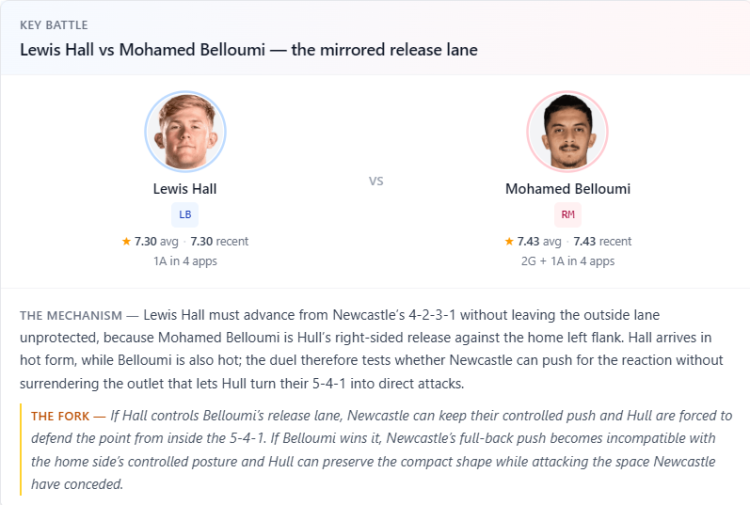
The key duel is Lewis Hall against Mohamed Belloumi. The Englishman is expected to advance from left-back, but every forward movement must be balanced against Belloumi’s position on Hull City’s right side. Hall has been one of Newcastle’s most productive selections, while Belloumi arrives after a strong start and is one of Hull’s main ways to turn a defensive phase into an attack.
If Hall controls that release lane, Newcastle can keep their full-back involved and maintain the controlled push their shape demands. Hull would then be forced to defend deeper inside the 5-4-1, with less opportunity to attack the space outside the home side’s left side.
If Belloumi wins the contest, Hall will have to choose between staying cautious and surrendering attacking width, or pushing on and leaving a route into the space behind him. There is no spare defender whose primary job is to erase that problem once Newcastle’s left-back has moved forward.
The central duel between Yoane Wissa and John Egan carries a different question. Wissa must occupy the middle of Hull’s back five and give Newcastle a point from which Joe Willock and the wide attackers can connect. Egan’s continuity makes him well placed to keep that reference contained.
If Wissa succeeds, Newcastle can attack through the centre and draw Hull’s defenders out of their compact line. However, if Egan keeps him away from useful positions, Jaissle’s charges are more likely to resort to the direct chase that their chosen approach is trying to avoid.
The draw has the stronger shape behind it
We lean towards a draw with medium confidence. Newcastle United have the home setting and the need to respond, but Hull City’s five-man block gives them a stable way to keep the match close.
The visitors do not need to open the game, and Matthias Jaissle’s men recent defensive numbers make it difficult to trust them as a strong home favourite. They have conceded an average of 1.85 expected goals per match across their last four, while Hull have kept three clean sheets in that span.
The strongest case against the draw is Newcastle finding the central access they need early. If Wissa can pull John Egan away from the middle and Joe Willock receives the ball between Hull’s midfield and defence, the hime side’s extra attacking presence could turn territorial pressure into a lead.
Lean: Draw
Range: 1-1/0-0/1-0
Lewis Hall then has more freedom to advance, and the home side can make Hull defend rather than release Belloumi into the space behind the full-back. That is the route to a Newcastle win, but it requires their defensive cover to survive the attacking commitment.
The likeliest scoreline range is 1-1, 0-0 or 1-0. Hull’s defensive structure makes a low-scoring match more plausible than an end-to-end contest, while Newcastle’s reaction should still give them enough attacking pressure to avoid being dismissed entirely.
The late selection call could change the balance
The remaining uncertainty in Hull City’s back five and central midfield matters because their plan depends on spacing and repetition more than individual attacking volume. If the final choices preserve the same distances between the three defenders, the two central midfielders and the lone striker, Newcastle may find the middle closed for long periods. If those connections are disrupted, even slightly, the home side’s familiar structure has a clearer route to the response it needs.
Comment / Reply From
You May Also Like