
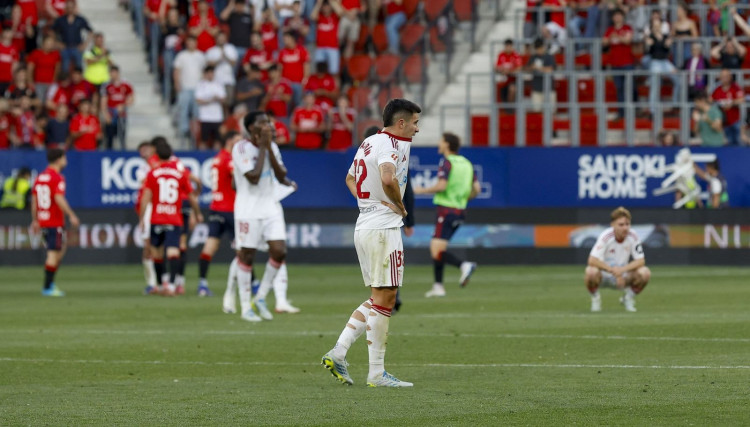
COLUMN: The end might be near for sorry Sevilla
Miguel L. Pereira can be found on social media here, and if you’re hungry for more, Miguel has also written a book delving into the heights and depths of Spanish football, and all it’s cultural and social layers. Find out more about it here.
The end might be near, but nobody can say that it would be a surprise if it happens. For the past two decades, people thought of Sevilla, and the first thing that came to mind was obviously someone from the side lifting the Europa League. Now, they are on the brink of their first relegation since the turn of the century. Civil war, bad decisions, a crowd that started to believe they were bigger than they actually were, the lack of backup from a youth system that was never properly taken care of, everything collided into making Sevilla a giant that might be on its way down.
This was once the club of Dani Alves. Of Frederic Kanoute, Luis Fabiano, Ivan Rakitic, Jesus Navas, and Sergio Ramos. The club that had never played in the last eight rounds of any continental football competition suddenly became the Real Madrid of the UEFA Cup/Europa League, winning more trophies than many football nations combined. European nights at the Sanchez Pizjuan felt different from anywhere else. Players signed for a dime were sold for millions, thus sustaining their competitive edge, particularly at the hands of wise and talented football managers. Their talent for picking out good coaches also made Sevilla tactically evolved, not just fuelled by talent on the pitch.
All of that has now come to an end. Sevilla is no longer playing European football, let alone dreaming of winning it. Long were the days when they were able to sign some of the future best players in the world below the radar, and turn them into local icons before selling them for a healthy profit. Even the managers they have brought in over the past few years are a cartoon version of the Unai Emerys or Juande Ramos’ of the past. No, that Sevilla is now gone, and nobody quite knows if they will ever be back.
Some clubs are defined by eras, and perhaps Sevilla will forever be the club of the late 2000s and the 2010s in the collective memory of football supporters, the same way Deportivo reminds you of the late 1990s and early 2000s or Real Sociedad at the turn of the eighties. There is no shame in that, of course. No club in Spain, bar Real Madrid and Barcelona, is strong enough to keep on being successful all of the time. Some juggernauts have been suffering from that illness, particularly Valencia, and that could also be the fate of Atletico Madrid once Diego Pablo Simeone finally leaves, who knows.
But in Seville, a city that ranks below no other in terms of passion, everything is lived in extremes. Football is no different. Ironically, as Real Betis are enjoying a rare golden hour over the past years, their city rivals are suffering, as if they didn’t even contemplate it being possible. And the ghost of the second tier looms close by.
The difficult situation is lived in different layers. For one, there are the supporters, those who felt entitled to believe they were actually aiming at becoming an Atletico Madrid of sorts without the reality to back it. It isn’t the first time. When Ramon Sanchez Pijzuan began building the stadium in Nervion that now bears his name, his goal was to have a ground as big as the Santiago Bernabeu because he felt his club should be at the same level as the big guns in the capital. When Sevilla started to claim their first UEFA Cup trophies. and even fought for La Liga for a couple of seasons in a row, most of the Sevillismo actually believed they had come to stay at the top.
A small bump along the way and a quick rebirth under Emery convinced them even more, as new trophy cabinets were ordered. But that was never going to be sustainable over time, and despite nobody coming to terms with the reality, in their hearts, they all knew. What few expected was that a club that had been well-run by Jose Maria del Nido, a chip off the old 1990s football chairman block, ended up in the middle of a civil war between the former chairman, later jailed due to his business as a lawyer with some shady local politicians, and his own son.
The family feud brought Sevilla into the spotlight for all the wrong reasons, and the club suffered greatly because of it. Monchi, the former goalkeeper turned into an godfather figure as sporting director, also seemed to lose his Midas touch once he was brought back from his ill-fated experiences abroad in 2019. The man who had once snapped up Alves or Rakitic under the radar of big clubs found more rocks than gems, and most of the deals he made actually became a burden in terms of wage bill, under the strict salary limit policy installed by La Liga. When he left, there was hardly a single player worthy enough of being sold for a profit, let alone a quality squad to fight for the top of the table.
🗣️ "Hay jugadores con salario elevado que no están participando. Te la estás jugando con los chavales"
🧐 @albertoowono analiza la delicada situación del Sevilla FC#PokerFC
— DAZN España (@DAZN_ES) April 27, 2026
And that is the crux of the issue. Sevilla are where they are because they belong there. Their squad is no better than most clubs that fight for staying in La Liga, and they weren’t even able to use all the money they brought in from Monchi’s golden era to rebuild their cantera, which in the past gave them Jose António Reyes, Sergio Ramos, Antonio Puerta and Jesus Navas.
The departure of the latter means there have been few heroes to emulate, homegrown or signed, over the past few years. Instead of bracing themselves for hard times, they kept on trusting managers who tried to sell the idea that the club was going places, and the crowd happily bought into it. They were wrong. With five games to go, Sevilla are strong candidates to be in the second tier next season, and it might actually be good for them to wake up from a sense of entitlement that has foreshadowed their demise. Whether they will be able to do so is another story. Now, they have a few weeks left to prove to themselves and the rest of the world that there is still something in them that resembles the great Sevilla sides of not so long ago. The clock is ticking.
Comment / Reply From
You May Also Like